

2–5 Business Days: Wine Delivery in Australia, When Cold Chain Matters
Most wine orders to Australian metro areas arrive within 2 to 5 business days; regional and remote deliveries typically add several extra days on top. The three things that shift that number the most are the retailer’s dispatch cutoff, how far the carrier has to travel, and whether the bottle needs temperature-controlled handling. Order before midday and you’re already ahead of most of the pack.
TL;DR:
- Dispatch cutoffs, order timing, and the need for temperature control significantly influence delivery speed, especially for regional and remote areas.
- Metro delivery typically takes 2 to 4 business days, but remote areas can experience delays of up to 7 additional days depending on distance and carrier.
- Receptions are affected by public holidays, peak seasons, and whether the order includes personalized or age-restricted items, often causing longer wait times.
- Cold-chain logistics are crucial for high-value or cellar-worthy bottles, with temperature-controlled shipping adding extra dispatch time.
- Free shipping thresholds vary by retailer, and bundling larger orders often reduces the per-bottle shipping cost.
Table of Contents
- What retailers mean by “delivery time” in Australia
- How dispatch cutoffs shape your delivery window
- How long does wine delivery take in each state?
- Which carriers handle wine, and when cold chain matters
- What happens if you’re not home for delivery
- Why deliveries slow down at certain times of year
- What shipping actually costs, and when free delivery kicks in
- How some retailers handle dispatch for rare and collectible bottles
- Speed or protection: my honest take on wine delivery trade-offs
- FU Wine: sourcing rare bottles without the retail markup
- Where these delivery details come from
- Sources
- FAQ
What retailers mean by “delivery time” in Australia
That “2 to 4 business days” line at checkout is doing more work than it looks. Business days exclude weekends and public holidays, so a Thursday order quoted “3 business days” might not land until the following Wednesday if a long weekend gets in the way.
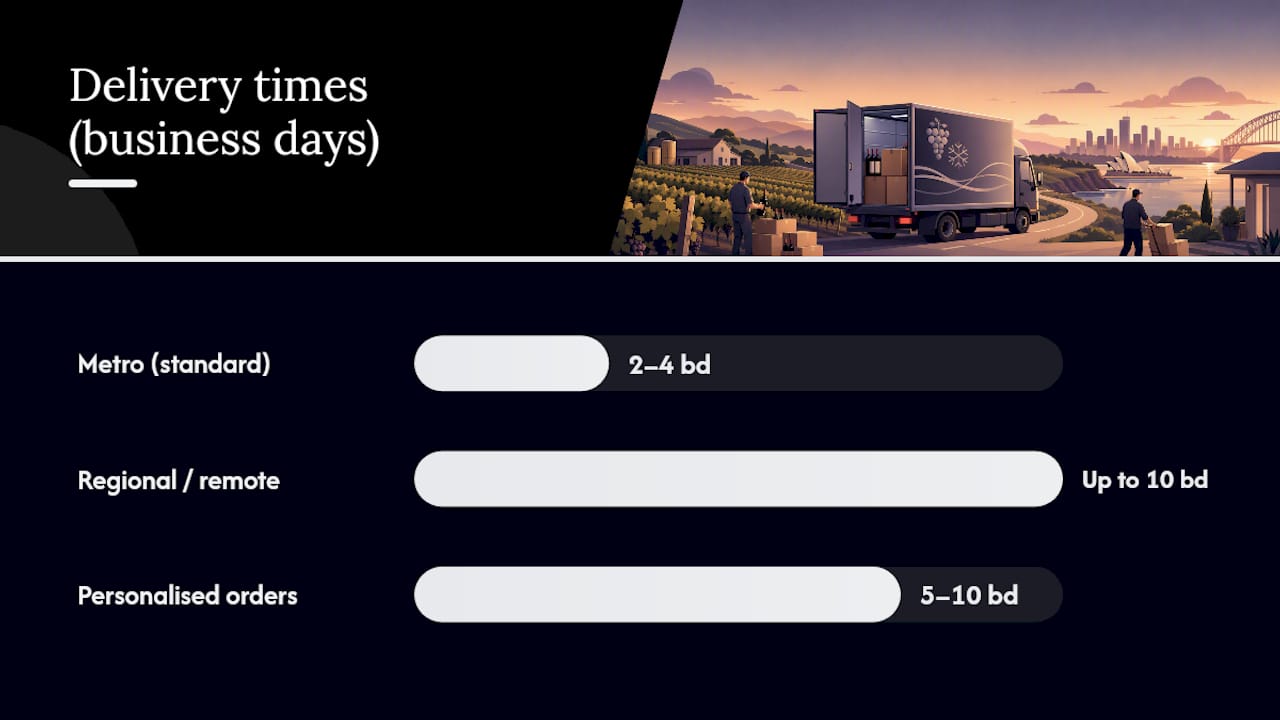
Two separate clocks are running here: dispatch (how long the retailer takes to pick, pack, and hand the parcel to a carrier) and transit (how long the carrier takes once it’s moving). A quoted delivery window covers both, and dispatch is often the part buyers underestimate. Half Sister Wines, for example, lists metro ranges around 2 to 4 business days but flags that regional and remote postcodes can stretch past 10 business days once transit distance is added.
Common phrasings you’ll see, and what they usually mean in practice:
- “2–4 business days” — a metro promise, assuming standard stock and no personalisation.
- “Allow up to 10 business days” — a regional or remote catch-all, built to cover worst-case transit.
- “Same day dispatch if ordered before midday” — a cutoff-based promise; it speaks to dispatch, not arrival.
- “5–10 business days for personalised orders” — extra prep time baked in before the parcel even ships.
Always check the estimate that appears at your own checkout with your postcode entered. Generic ranges on a shipping page are a guide, not a guarantee.
How dispatch cutoffs shape your delivery window
Before a bottle ever sees a courier van, it has to be picked, packed, and labelled. Most Australian wine retailers run a daily cutoff, commonly midday Monday to Friday, and that single detail changes your outcome more than almost anything else. Order at 11:45am and you’re often in the same-day dispatch batch. Order at 12:15pm and you’ve just added a full business day before transit even starts.
Curated hampers, gift-wrapped bottles, and personalised engravings sit outside the standard cutoff rhythm. Moët Hennessy Australia’s shipping policy indicates personalised orders require additional dispatch time before transit begins.
A simple pre-order checklist keeps you out of trouble:
- Check the retailer’s stated cutoff time and place your order before it if timing matters.
- Confirm your delivery address and postcode are correct at checkout, not just saved from a previous order.
- Only pay for express shipping when the date genuinely can’t move, since it’s rarely worth it otherwise.
Pro Tip: If a bottle is a birthday or event gift, work backwards from the date you need it, add the retailer’s dispatch cutoff delay, then add another day as a buffer for weekends. That buffer has saved more dinner parties than express shipping ever has.
How long does wine delivery take in each state?
Distance from the dispatch warehouse (usually in a major eastern-seaboard city) drives most of the state-to-state difference you’ll see. Metro delivery is fairly consistent; regional and remote areas are where the range really opens up.
Typical metro business-day ranges look like this:
- ACT: 2 to 3 business days
- NSW (Sydney): 2 to 4 business days
- VIC (Melbourne): 2 to 4 business days
- QLD (Brisbane): 2 to 5 business days
- SA (Adelaide): 1 to 4 business days
- WA (Perth): 4 to 7 business days
- TAS: 4 to 6 business days
- NT: longer and more variable, depending on the carrier’s regional network
Step outside a capital city and add roughly 2 to 7 extra business days, with the longest waits typically in remote Western Australia, remote Tasmania, and outback areas of the Northern Territory. If you’re curious how Tasmania’s geography plays into both wine production and delivery quirks, it’s worth a closer look at the state’s cool-climate wine scene. Every retailer and carrier reports these ranges slightly differently, so treat state averages as a planning tool and trust the postcode-specific estimate you get at checkout over any general rule.
Which carriers handle wine, and when cold chain matters
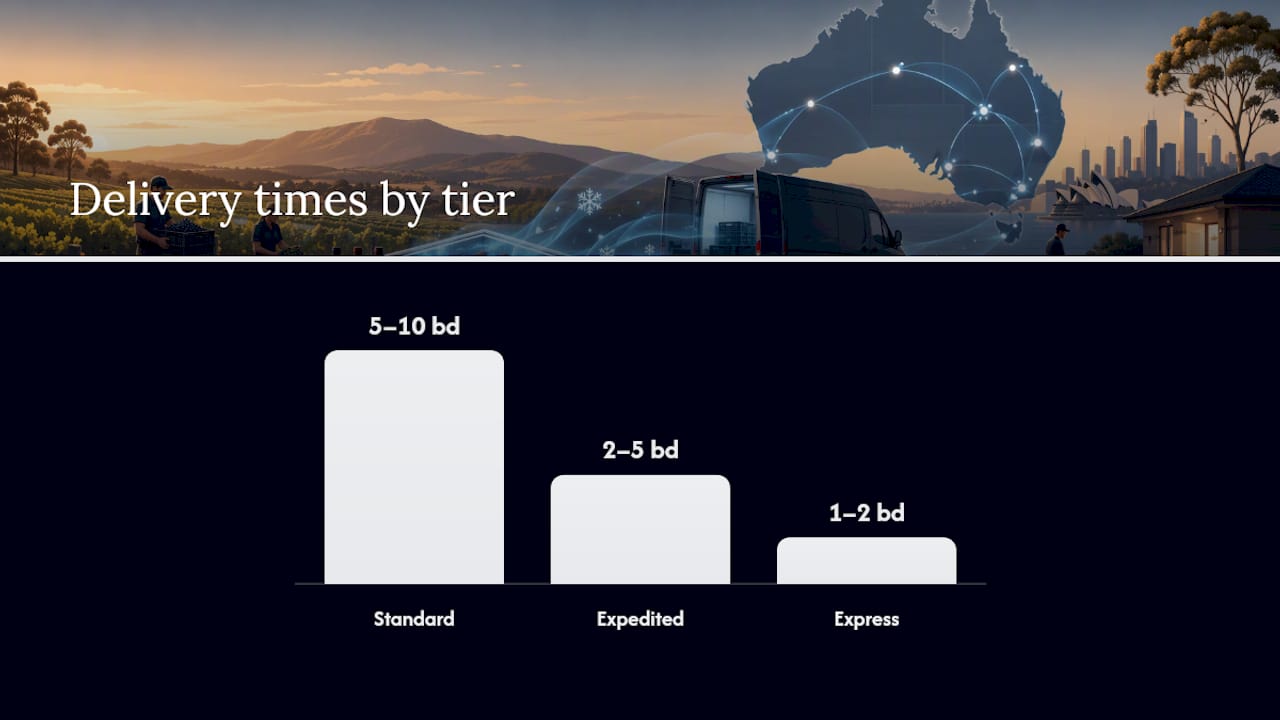
Metro orders usually travel with national courier networks, while Australia Post tends to pick up the PO box deliveries and the harder-to-reach regional routes that courier networks don’t cover efficiently. Pack & Send describes three common domestic tiers for wine freight: standard at 5 to 10 business days, expedited at 2 to 5 business days, and express at 1 to 2 business days where the route supports it.
Speed isn’t the only variable that matters for wine. Heat is the real enemy of anything cellar-worthy, and Australia’s summer transit routes can sit a parcel in a hot depot for hours. Cold-chain logistics, purpose-built temperature-controlled networks, exist specifically to stop that kind of heat damage to sensitive goods in transit.
- Standard courier: fine for everyday drinking wine bought in cooler months.
- Cold-chain or temperature-controlled freight: worth the extra dispatch time for cellar-aged or high-score bottles.
- Ordering in summer, or shipping to/from a warmer state: treat temperature control as close to essential for anything collectible.
One detail worth remembering: temperature-controlled shipping usually adds dispatch time rather than transit speed, because the packing process itself is more involved.
What happens if you’re not home for delivery
Alcohol delivery in Australia comes with rules that standard parcels don’t, and it pays to know them before the courier’s at your door.
- Authority to leave varies by retailer and order value; many businesses will redirect higher-value orders straight to a local post office rather than leave them unattended.
- Proof of age is mandatory. Have photo ID ready, because drivers are legally required to check age and can refuse to hand over the parcel without it, even if you’ve already paid.
- Missed deliveries typically trigger a re-delivery attempt, a card inviting you to collect from a depot, or a hold at a nominated post office. Repeated failed attempts can carry extra fees, so it’s worth tracking your shipment rather than assuming it’ll simply turn up. If you’re sending wine to someone else rather than receiving it yourself, the same age-verification rules apply on their end, which is worth knowing before you send wine as a gift.
Why deliveries slow down at certain times of year
Peak periods put pressure on every part of the network at once, from warehouse picking to last-mile courier runs. End-of-year holidays, major promotional sale events, and long public-holiday weekends all tend to push delivery windows out by a few extra days compared with quieter months. Retail data on Australian beverage buying patterns shows just how concentrated demand gets around these periods, which is exactly when depots get congested and courier staffing gets stretched thin (see industry analysis on Australian beverage retail behaviour).
- Expect longer waits in the weeks around Christmas, Easter, and major sale events.
- Track your shipment number as soon as it’s issued rather than waiting to worry about it.
- Contact the retailer early if a parcel looks stalled, since problems are easier to fix before the delivery date has passed.
- If a date is fixed and non-negotiable, book express shipping well ahead of the event rather than trusting a standard window to stretch to fit.
What shipping actually costs, and when free delivery kicks in
Standard shipping is usually charged per order or per case, and most Australian wine retailers set a free-shipping threshold once your order value clears a certain point, though the exact figure varies retailer to retailer.
- Paying for express or temperature-controlled shipping only really makes sense for urgent or genuinely high-value bottles.
- Ordering a full case rather than single bottles almost always lowers your shipping cost per bottle.
- Larger orders are also more likely to clear a free-shipping threshold outright, so bundling purchases can be the cheaper path even before you factor in the convenience.
How some retailers handle dispatch for rare and collectible bottles
Sourcing limited-release and cellar-aged stock means not all bottles sit in one warehouse ready to ship immediately. A rare vintage might come from a different storage location than a standard case, which can shift dispatch timing compared to buying mass-market stock from a big-box retailer.
For high-value or genuinely collectible bottles, that sometimes means specialist handling or temperature-controlled fulfilment to protect what you’re paying for, rather than the fastest possible dispatch. If a purchase is time-critical, check the dispatch notes on the product page first and reach out to customer service directly. It’s a five-minute question that can save you a week of guessing.
Speed or protection: my honest take on wine delivery trade-offs
Fast delivery and safe delivery aren’t always the same goal, and pretending otherwise is how good bottles end up cooked in a hot depot. For everyday drinking wine, chase the quickest dispatch cutoff you can hit. For anything cellar-aged or collectible, pay the extra day or two for temperature-controlled handling; the wine inside is worth more than the convenience of arriving Tuesday instead of Thursday.
— Damien
FU Wine: sourcing rare bottles without the retail markup
Some wine businesses exist because premium and hard-to-find wine shouldn’t only be available to industry insiders at industry prices. Their catalogues can rotate through limited releases, boutique producer runs, and cellar-aged bottles sourced through direct relationships and opportunistic buys, which means dispatch can look a little different from a standard bottle shop.

Because stock is sourced for scarcity and quality rather than warehouse convenience, some bottles ship from different locations, and genuinely collectible pours may get specialist or temperature-controlled handling to protect what you paid for. If timing matters for a gift or an event, check the dispatch notes on the product page before you buy, and flag it with customer service if you need it sooner. Ready to see what’s on offer right now? Check current stock and shipping estimates at FU Wine before this week’s drops sell out.
Where these delivery details come from
For readers who want the primary sources: Wine Australia’s WALAS system governs shipping approvals for certain wine movements, and Pack & Send’s courier guide covers domestic freight tiers and cold-chain logistics in more depth.
Sources
FAQ
What is the 20-minute wine rule?
It’s not a delivery standard. It’s a serving guideline suggesting red wine should breathe for around 20 minutes before drinking to open up its aroma and soften tannins, unrelated to shipping times.
How long does BWS take to deliver?
Delivery windows vary by store and location, and BWS doesn’t publish a single fixed national figure. Check the estimate shown at checkout for your specific postcode rather than relying on a general timeframe.
What are Virgin Wines’ delivery hours and typical timeframes?
Specific delivery hours depend on the courier servicing your postcode, and Virgin Wines doesn’t list a universal Australian delivery window. As with any retailer, the checkout estimate for your address is the figure to trust.
What’s the best wine delivery service in Australia?
It depends what you’re buying. For everyday cases, a retailer with a clear midday dispatch cutoff and solid metro courier coverage will get you there fastest. For rare or collectible bottles, prioritise a retailer offering temperature-controlled handling, like FU Wine, over one that’s simply quickest.
How long should I expect to wait for wine delivery in Australia overall?
Budget 2 to 5 business days for metro orders and add several extra days for regional or remote postcodes. Personalised items and peak sale periods can extend that window further, so check your specific checkout estimate before assuming a date.