

Comparing old world and new world wines: your guide
TL;DR:
- Old World wines emphasize terroir, restraint, and high acidity, while New World wines focus on ripe fruit and fuller body. Australian regions showcase a full spectrum, from warm-climate Barossa Shiraz to cool-climate Tasmania Pinot Noir. Style differences result mainly from winemaking choices and climate, with convergence increasing across regions.
Old World wines favour restraint, high acidity, and terroir expression; New World wines lean into ripe fruit, fuller body, and producer-led style. That single sentence is the whole map. A Barossa Valley Shiraz sitting at 14.5% ABV with plush dark fruit is textbook New World. A Burgundy Pinot Noir at 12.5% ABV with earthy, savoury complexity is textbook Old World. Tasmania’s cool-climate Pinot and Margaret River Chardonnay sit somewhere in between, deliberately blurring the line.
When to pick each style:
- Old World (Burgundy, Barolo, Rioja): food on the table, a long dinner, or a bottle you want to age.
- New World, warm sites (Barossa Shiraz, McLaren Vale Grenache): barbecue, casual Friday, bold flavours.
- New World, cool sites (Yarra Valley Pinot, Tasmanian sparkling): celebratory occasions, seafood, or when you want Old World restraint with Australian provenance.
Table of Contents
- How do old world and new world wines actually taste different?
- What are the classic old world wine regions?
- Which new world regions should you know, including Australian ones?
- What does the label tell you, and what are Australia’s GI rules?
- How do winemaking choices create these style differences?
- Are old and new world styles converging?
- How do you taste old world vs new world side by side?
- Which style suits your food, occasion, or gift?
- Common myths about old world and new world wines, debunked
- When the old/new label stops mattering
- Key takeaways
- The honest truth about choosing sides
- Premium bottles from both worlds, without the markup
- Useful sources
How do old world and new world wines actually taste different?
The most reliable sensory axis is acidity versus fruit weight. Old World wines typically sit at 12–13.5% ABV with mouthwatering acidity and a savoury, mineral edge. New World wines commonly reach 13.5–15% ABV, with softer acidity and a fruit-forward palate that hits you immediately.
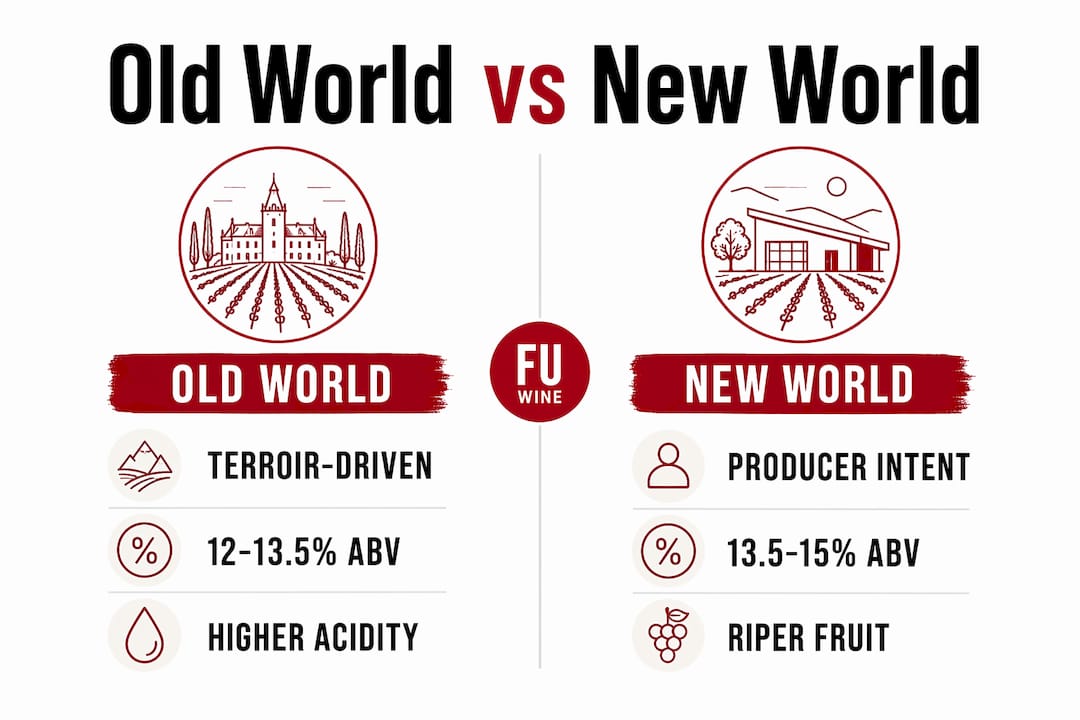
Here is how the two styles compare across the key dimensions:
| Dimension | Old World tendency | New World tendency |
|---|---|---|
| Body | Light to medium | Medium to full |
| Acidity | High, mouthwatering | Moderate, softer |
| Perceived alcohol | Lower, integrated | Higher, warming |
| Fruit vs savoury | Earthy, mineral, savoury | Ripe, jammy, fruit-forward |
| Oak | Neutral or aged French oak | New American or French oak |
| Tannin texture | Firm, grippy, drying | Plush, rounded, approachable |
| Label emphasis | Region or appellation | Grape variety |
| Food pairing | High-acid, food-driven | Standalone or casual |
A few single-sip markers worth memorising:
- Mouthwatering acidity that makes you salivate: Old World signal.
- Vanilla, coconut, or toast on the nose: new oak, common in New World styles.
- Earthy, forest floor, or dried herb aromas: Old World terroir expression.
- Jam, ripe plum, or blackcurrant with a warm finish: New World ripeness.
Alcohol reads on the palate as warmth at the back of the throat. Higher alcohol wines feel noticeably heavier and warmer than lower alcohol ones. High acidity, meanwhile, is what makes a wine feel “food-friendly” — it cuts through fat and protein the way a squeeze of lemon does on fish.
What are the classic old world wine regions?
Old World geography is Europe and the Mediterranean basin, where viticulture has existed for thousands of years. The Phoenicians, Greeks, and Romans established the earliest vineyards, and centuries of trial and error produced the appellation systems that govern these regions today. France’s Appellation d’Origine Contrôlée (AOC), Italy’s Denominazione di Origine Controllata (DOC), Spain’s Denominación de Origen (DO), and Portugal’s Denominação de Origem Controlada (DOC) all enshrine traditional practices into law, from permitted grape varieties to maximum yields per hectare.
Key regions and their style signatures:
- Burgundy, France: Pinot Noir and Chardonnay; earthy, mineral, restrained. The benchmark for terroir-driven wine.
- Bordeaux, France: Cabernet Sauvignon and Merlot blends; structured, tannic, built for ageing.
- Champagne, France: Chardonnay, Pinot Noir, Pinot Meunier; high acidity, fine bubbles, toasty complexity.
- Barolo, Italy: Nebbiolo; powerful tannins, rose petal and tar aromas, long ageing potential.
- Chianti, Italy: Sangiovese; bright cherry, high acidity, earthy finish. Brilliant with tomato-based dishes.
- Rioja, Spain: Tempranillo; vanilla, dried fruit, often aged in American oak for a distinctive coconut note.
- Priorat, Spain: Garnacha and Carignan on slate soils; concentrated, mineral, intense.
- Mosel/Rheinhessen, Germany: Riesling; razor-sharp acidity, slate minerality, low alcohol, ages magnificently.
- Douro, Portugal: Touriga Nacional blends; dark fruit, firm tannins, the home of Port.
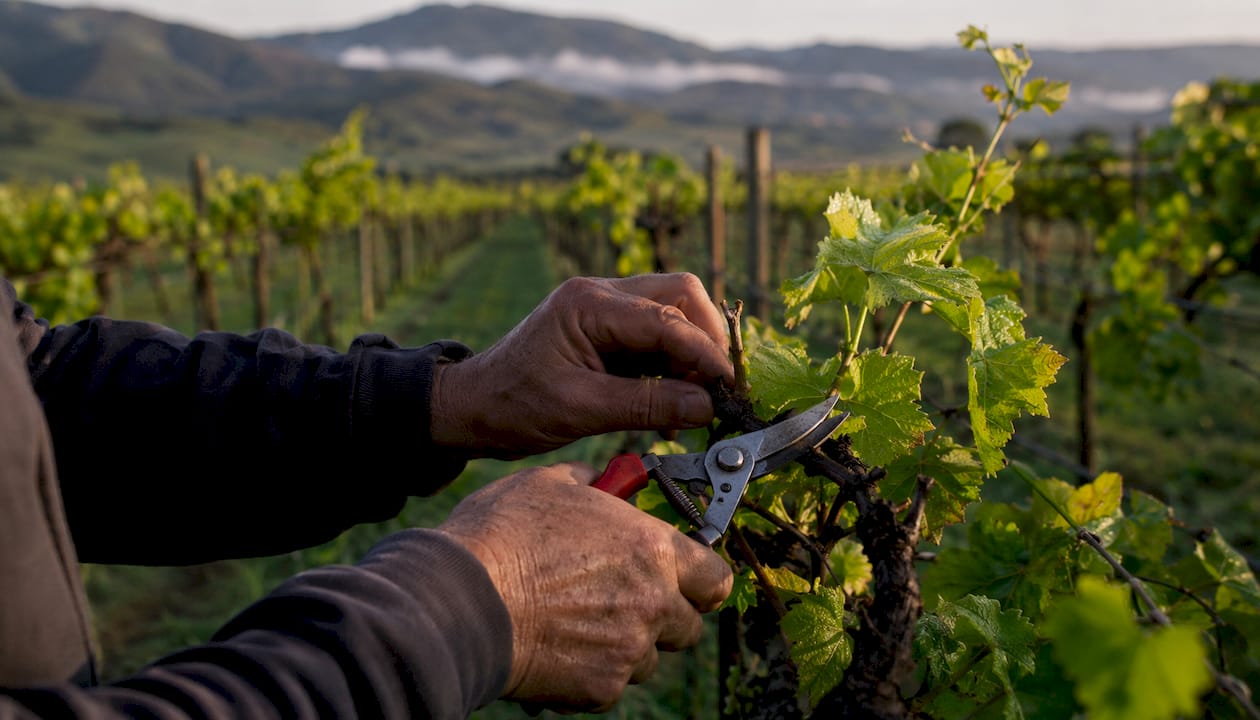
Two regions worth knowing beyond the mainstream: Georgia (arguably the world’s oldest wine culture, with amber wines made in clay qvevri vessels) and Lebanon’s Bekaa Valley, where producers like Château Musar have been making age-worthy reds for decades. Both are seeing renewed collector interest.
Which new world regions should you know, including Australian ones?
New World wine refers to regions where European viticulture arrived after the 15th century, carried by colonisers and missionaries. The category covers the Americas, South Africa, Australia, and New Zealand. The geographic definition is fairly clean; the stylistic one is messier, because “New World” increasingly describes a philosophy (fruit-forward, producer-led, technologically assisted) rather than a postcode.
Representative regions at a glance:
- Napa Valley, California: Cabernet Sauvignon; full-bodied, opulent, new-oak driven. High price points.
- Willamette Valley, Oregon: Pinot Noir; cooler, more restrained, deliberately Old World in approach.
- Mendoza, Argentina: Malbec; plush dark fruit, violet aromas, excellent value at mid price points.
- Central Valley and Casablanca, Chile: Carménère and Sauvignon Blanc; fresh, approachable, consistent.
- Stellenbosch, South Africa: Cabernet Sauvignon and Chenin Blanc; structured reds, vibrant whites.
- Marlborough, New Zealand: Sauvignon Blanc; intensely aromatic, passionfruit and cut grass, high acidity.
- Central Otago, New Zealand: Pinot Noir; cool-climate, spicy, silky tannins.
Australian regions and where they sit on the spectrum
Australia is not one wine style. The country spans climates from the scorching Barossa floor to the near-freezing peaks of Tasmania, and that range produces wines that sit at very different points on the Old/New axis.
- Barossa Valley, SA: Shiraz; the poster child for New World ripeness. Dark fruit, chocolate, pepper, high alcohol. Some of the oldest Shiraz vines on earth.
- McLaren Vale, SA: Grenache and Shiraz; plush, warm, Mediterranean in character. Ripe and generous.
- Margaret River, WA: Cabernet Sauvignon and Chardonnay; arguably Australia’s most “Old World” warm-climate region. Structured, mineral, built for the table.
- Yarra Valley, VIC: Pinot Noir and Chardonnay; cool-climate elegance, restrained fruit, high acidity. Closer to Burgundy in philosophy than Barossa.
- Tasmania: Pinot Noir, Chardonnay, and sparkling; the coolest major wine region in Australia. Wines here genuinely mimic Old World restraint, with premium wine trends increasingly pointing collectors toward Tasmanian producers.
The key insight is that “New World” is not homogeneous. A Tasmanian Pinot Noir and a Barossa Shiraz are both Australian, both technically New World, and they taste nothing alike.
What does the label tell you, and what are Australia’s GI rules?
Old World labels emphasise place; New World labels emphasise grape variety. That is not a style preference — it is a regulatory outcome. A bottle labelled “Chablis” is telling you it comes from a specific appellation in northern Burgundy where only Chardonnay is grown under strict AOC rules. A bottle labelled “Chardonnay” from South Australia is telling you the grape, not the place.
Why the difference exists: Old World appellation systems assume that place communicates everything — variety, style, quality level. New World frameworks, including Australia’s Geographic Indications (GIs), define a boundary and require that a stated percentage of the wine’s grapes come from within it, but they do not dictate varieties or winemaking methods.
Statistic to know: Under US American Viticultural Area (AVA) rules, 85% of grapes must come from the named region for the label to carry that AVA. Australia’s GI system operates on a similar provenance threshold for regional claims.
Label-reading tips for Australian shoppers:
- Region on the front, no grape variety: likely Old World or Old World-style. Expect terroir expression.
- Grape variety prominent on the front: New World convention. The producer is selling you the fruit character.
- “Estate grown” or “single vineyard”: producer is signalling site specificity, regardless of Old/New origin.
- Back label winemaker notes: read them. A producer who talks about soil and site is leaning Old World in philosophy; one who talks about “ripe fruit and approachable tannins” is leaning New World.
Australian GI rules also govern varietal labelling: a wine labelled as a single variety must contain at least 85% of that variety. Blends must list varieties in descending order of volume. These rules make Australian labels among the most transparent in the New World.
How do winemaking choices create these style differences?
Old World prioritises terroir and tradition; New World prioritises producer expression and modern technique. That philosophical gap drives almost every stylistic difference you taste in the glass.
The key production decisions:
- Yields: Old World appellations often cap yields per hectare by law, concentrating flavour. New World producers manage yields commercially, with more flexibility.
- Yeast: Old World winemakers favour wild, ambient yeast as part of terroir expression. New World producers commonly use cultured yeast strains for consistency and predictability.
- Temperature control: New World wineries invest heavily in temperature-controlled fermentation to preserve fresh fruit aromas. Traditional Old World cellars relied on ambient temperatures, producing more complex, sometimes funky ferments.
- Oak strategy: Old World producers typically use large, old, neutral oak barrels (or none at all) so the wood does not mask terroir. New World producers more often use new American or French oak barriques, adding vanilla, toast, and spice.
- Extended maceration: Old World reds (especially Barolo and Burgundy) often undergo long skin contact, building firm tannins and complexity that need years to resolve. New World reds are more commonly made for earlier drinking.
The same grape variety can taste radically different depending on these choices. A Chardonnay fermented in neutral old oak with no malolactic conversion reads lean, mineral, and tense. The same variety in new American oak with full malolactic conversion reads buttery, toasty, and generous.
Pro Tip: To spot new oak in a tasting, look for vanilla, coconut, or dill on the nose. Coconut and dill specifically signal American oak; French oak tends toward subtler toast and spice. If those aromas dominate, the producer is leaning New World in technique, regardless of geography.
Are old and new world styles converging?
Yes, and faster than most wine guides acknowledge. The Old/New binary is increasingly unreliable as a tasting tool, because climate and deliberate stylistic crossover are pulling both camps toward the middle.
What is driving the shift:
- Warmer Old World vintages: Burgundy, Bordeaux, and the Rhône are producing riper, higher-alcohol wines than they did 30 years ago. Some recent Burgundy vintages have reached alcohol levels that would have been considered New World a decade ago.
- Cooler New World sites: Producers in Tasmania, Willamette Valley (Oregon), and Sonoma Coast are deliberately targeting lower-alcohol, terroir-expressive styles. Cool New World sites like Tasmania’s Huon Valley are producing Pinot Noir and sparkling wines that read Old World in structure and restraint.
- Flying winemakers and knowledge exchange: Winemakers trained in Burgundy now work harvests in the Yarra Valley. Producers in Languedoc make variety-labelled, internationally-styled wines that feel New World in approach despite their French address.
For Australian collectors, this convergence is genuinely exciting. A Tasmanian Chardonnay from a cool vintage can sit comfortably alongside a white Burgundy in a blind tasting. Conversely, a warm Barossa vintage can push Shiraz into a richness that rivals the biggest Rhône reds.
The practical takeaway: use Old/New as a starting point, not a verdict. Producer philosophy and vintage conditions matter more than geography when you are choosing a bottle to age.
How do you taste old world vs new world side by side?
The method is straightforward: appearance, nose, palate, finish. Sommeliers use the Old/New axis as an initial deduction in blind tasting, then confirm with acidity, tannin texture, oak profile, and vintage character.
Step-by-step tasting checklist:
- Appearance: Deeper, inky colour often signals warmer climate and riper fruit (New World). Paler, translucent colour suggests cooler climate or Old World restraint.
- Nose, primary aromas: Fresh red or black fruit, floral notes, and clean fruit = New World tendency. Earthy, forest floor, dried herb, or farmyard complexity = Old World tendency.
- Nose, secondary aromas: Vanilla, coconut, toast = new oak (New World technique). Savoury, mineral, or oxidative notes = Old World technique.
- Palate, acidity: Does your mouth water? High acidity = Old World signal. Soft, round, less salivating = New World tendency.
- Palate, tannin: Grippy and drying = Old World structure. Plush and velvety = New World winemaking.
- Palate, alcohol: Warmth at the back of the throat. Pronounced heat = likely New World ABV range.
- Finish: Long, savoury, mineral finish = Old World. Fruit-driven, warm, shorter finish = New World.
Pinot Noir side by side: the best example
Pinot Noir is the most instructive grape for this comparison because the same variety is grown seriously in both camps.
| Trait | Burgundy-style (Old World) | Tasmanian/Oregon (cool New World) | Warm California |
|---|---|---|---|
| Colour | Pale ruby, translucent | Medium ruby | Deep ruby |
| Nose | Earth, dried rose, forest floor | Red cherry, spice, subtle earth | Ripe cherry, jam, vanilla |
| Acidity | High, mouthwatering | High to medium-high | Moderate |
| Tannin | Firm, silky with age | Silky, fine | Soft, plush |
| Alcohol | Lower | Medium | Higher |
| Finish | Long, savoury, mineral | Long, fruit and spice | Warm, fruit-forward |
Riedel and other glassmakers actually design different glass shapes for Old World versus New World expressions of the same grape, recognising that the structural differences in the wine require different delivery to the palate.
Which style suits your food, occasion, or gift?
Acidity and restraint suit food; ripe fruit and plush texture suit casual occasions. That is the practical rule.
Food pairing by style:
- Grilled barramundi or Sydney rock oysters: high-acid Old World white (Chablis, Mosel Riesling) or a cool-climate Australian Riesling from Clare Valley. The acidity cuts through the brine.
- Barbecued beef brisket or lamb shoulder: Barossa Shiraz or McLaren Vale Grenache. The ripe fruit and tannin stand up to char and fat.
- Italian family meal, pasta with tomato: Chianti Classico or a Sangiovese-based red. High acidity and savoury notes are built for this.
- Roast lamb with saffron and herbs: Margaret River Cabernet Sauvignon. Structured, earthy, and long enough to carry the spice.
- Celebration or gift: Tasmanian sparkling or a Champagne-method wine. The cool-climate acidity and fine bubbles work for almost any occasion.
For pairing white wine with food in more detail, this pairing guide covers Australian examples thoroughly.
Occasion and gifting guidance:
- Casual Friday or barbecue: New World, warm-climate. Approachable, generous, no fuss.
- Dinner party starter: Old World white or cool-climate Australian white. Acidity keeps palates fresh.
- Cellar purchase: Old World reds (Barolo, Burgundy, Bordeaux) or structured New World reds (Margaret River Cabernet, aged Barossa Shiraz). Both reward patience.
- Corporate gift: a high-scoring, recognisable label. Old World appellations carry prestige; New World single-vineyard bottles carry story.
Price and value: The middle market often favours New World consistency and value, while Old World dominates both the very high and very low price points globally. For Australian shoppers, mid-range Australian Shiraz or Chardonnay often offers strong drinkability compared to many European wines in the same price range. At higher price points, Old World provenance and ageing potential often add justification for a premium.
Common myths about old world and new world wines, debunked
Old World is not inherently better. That is the top myth, and it is worth saying plainly. The categories describe different philosophies, not different quality tiers. A $30 Chianti and a $30 Barossa Shiraz are both excellent wines doing completely different things.
Myth vs fact:
- Myth: Old World wines are always more complex. Fact: Complexity depends on producer, site, and vintage, not geography. A boutique Tasmanian Pinot can be as complex as a village Burgundy.
- Myth: New World wines are always cheaper. Fact: Napa Valley Cabernet Sauvignon and single-vineyard Australian Shiraz reach prices that rival top Bordeaux.
- Myth: The region on the label tells you exactly what the wine tastes like. Fact: Within any region, producer philosophy creates enormous variation. Two Barossa Shirazes from different producers can taste like different grapes.
- Myth: High alcohol means low quality. Fact: Alcohol is a stylistic outcome of climate and winemaking intent. A 15% Barossa Shiraz made with skill is a better wine than a poorly made 12.5% Burgundy.
Understanding both styles rather than favouring one is the approach wine educators consistently recommend.
Practical buying checklist for Australian shoppers:
- Check the ABV. Under 13%: expect Old World-style restraint. Over 14%: expect New World ripeness.
- Read the label emphasis. Region-first = Old World logic. Variety-first = New World logic.
- Look for vintage notes on the back label. Significant variation year to year = Old World marginal climate. Consistent = New World warm climate.
- Research the producer’s philosophy. A producer who talks about soil and site is thinking Old World, regardless of postcode.
- Use a buying checklist to avoid the most common purchasing errors.
For collectors: focus on producer reputation, provenance documentation, and ageing potential over the Old/New label. For casual drinkers: buy by occasion and food, not by geography.
When the old/new label stops mattering
Beyond the label, producer intent and quality matter more for collectors than any geographic binary. That is not a contrarian take — it is what the evidence points to.
The most interesting bottles right now sit at the intersection of both philosophies. A Yarra Valley producer using wild yeast, neutral oak, and low yields is making wine with Old World intent from New World soil. A Languedoc producer using new oak and variety labelling is doing the opposite. Neither fits neatly into the binary, and both can be extraordinary.
For collectors, the practical signals worth tracking:
- Provenance documentation: where the grapes came from, how the wine was stored, and the chain of custody from producer to buyer.
- Producer track record: consistent quality across vintages matters more than appellation prestige.
- Scarcity and allocation: small-run boutique wines from either camp often outperform their price point precisely because they are made without commercial compromise.
FU Wine’s model is built around accessing rare bottles that defy simple categorisation — cellar-aged stock, boutique producer runs, and limited releases from both Old and New World producers. Australian shipping and stock rotation mean availability changes regularly, so checking current listings is the practical move.
Key takeaways
Old World wines express terroir through high acidity and restraint; New World wines express producer intent through ripe fruit and fuller body, with Australian regions spanning the full spectrum from Barossa’s warmth to Tasmania’s cool-climate precision.
| Point | Details |
|---|---|
| ABV is your first clue | Old World typically 12–13.5% ABV; New World typically 13.5–15% ABV. |
| Label emphasis signals philosophy | Region-first labels follow Old World logic; variety-first labels follow New World convention. |
| Australia spans both styles | Barossa and McLaren Vale lean New World; Yarra Valley, Margaret River, and Tasmania lean Old World in restraint. |
| Style does not equal quality | Old World and New World are different lenses, not different quality tiers — buy by occasion and producer intent. |
| FU Wine for rare bottles | FU Wine sources premium and limited-release bottles from both camps at significant discounts to traditional retail. |
The honest truth about choosing sides
The Old World versus New World debate is one of those wine conversations that sounds more important than it is. Spend enough time tasting both, and you stop picking sides. You start picking producers.
The most memorable bottles I have encountered do not announce their geography. They announce their maker’s intent. A Tasmanian Pinot that drinks like a Chambolle-Musigny. A Barossa Shiraz that has been aged long enough to develop the savoury complexity you expect from a Côte-Rôtie. These wines exist because producers stopped caring about the binary and started caring about the glass.
My practical advice: buy one Old World bottle and one New World bottle at a similar price point. Taste them side by side with the same food. The difference will teach you more in one sitting than any article can. Then do it again with Australian examples — a Yarra Valley Pinot next to a Burgundy, or a Margaret River Chardonnay next to a Chablis. The comparison becomes addictive.
Three things to do this week:
- Pick one Old World red (Chianti, Rioja, or a village Burgundy) and one New World red at a similar price.
- Taste them blind if you can — pour them into numbered glasses and try to identify which is which using the tasting checklist above.
- Browse a curated selection of rare and limited-release bottles to find something that genuinely surprises you.
Premium bottles from both worlds, without the markup
FU Wine exists for exactly this kind of exploration. The premise is simple: premium wine should not cost a premium price just because it comes with a prestigious postcode.
FU Wine sources cellar-aged stock, boutique producer runs, and limited releases from Old and New World producers alike, making them available at prices typically 30–70% below traditional retail. The rotating catalogue means you will find a Barossa single-vineyard Shiraz sitting next to a small-production Burgundy-style Pinot from Tasmania, both at prices that make the comparison genuinely affordable. Stock changes regularly, so what is available today may not be there next week.
Australian shipping is available, and the deal-driven model means the best bottles move fast. Browse the current selection at fuwine.com.au and confirm stock and shipping details at time of purchase.
Useful sources
- Wine Folly: New World vs Old World Wine — the clearest visual and conceptual explainer of the Old/New distinction, including ABV ranges and style tendencies.
- Wine Australia: Labelling Requirements — the primary Australian authority on GI rules, varietal labelling thresholds, and provenance claims.
- Global Wine Authority: Old World vs New World — detailed breakdown of regulatory frameworks, AVA rules, and the philosophical differences between the two camps.
- Sommelier Authority: Old World vs New World — explains how sommeliers use the binary as a deductive tool in blind tasting and where it breaks down.
- VinePair: Guide to Old World vs New World Wines — accessible educator-style overview recommending comparative tasting over picking sides.
- The Wine Guide: Old World vs New World — practical buying and value notes, including the mid-market dynamics that favour New World consistency.
- Wikipedia: New World Wine — comprehensive geographic and historical overview of New World wine regions, including Australia’s history and regional specialities.
- Wikipedia: Old World Wine — detailed coverage of Old World appellation systems, terroir philosophy, and vineyard structure differences.
- FU Wine — curated access to premium and rare bottles from Old and New World producers, with rotating stock and significant discounts on traditional retail pricing.