

Distressed wine inventory: what collectors need to know
TL;DR:
- Distressed wine inventory involves discounted stock sold due to oversupply, market shifts, or storage issues. These wines often offer opportunities for collectors who carefully evaluate provenance, condition, and market data before purchasing. Wise collectors use distressed inventory strategically to diversify, enjoy, and build their wine cellars effectively.
Not every bottle in a prestigious cellar sells for what it’s worth. Some of the finest wines in the world end up discounted, offloaded quietly, or channelled through brokers at a fraction of their original price. That’s the reality of explaining distressed wine inventory, and it’s one of the best-kept secrets in the collecting world. If you’ve ever wondered why a high-scoring Barossa Shiraz or a respected Burgundy suddenly appears at 50% off, the answer usually isn’t quality. It’s market mechanics. And once you understand those mechanics, you stop asking why and start asking where.
Table of Contents
- What is distressed wine inventory and why does it exist
- Market context: how consumer trends and storage costs drive inventory distress
- Understanding risks and valuation challenges with distressed wine
- How wine destocking firms operate and what collectors should know
- Practical tips for collectors navigating distressed wine inventory
- Rethinking distressed wine inventory: a collector’s fresh perspective
- Discover premium wines and discounts with FU Wine
- Frequently asked questions
Key Takeaways
| Point | Details |
|---|---|
| Distressed wine inventory | Refers to unsold or excess wine sold at discounts due to market and supply imbalances. |
| Market forces | Shifting consumer tastes and storage costs contribute heavily to wine inventory distress. |
| Valuation risks | Physical condition and provenance documentation critically affect distressed wine value. |
| Destocking firms | Specialist brokers facilitate discounted sales while protecting producer brands and managing risk. |
| Collector strategies | Buy wines suited to your taste and environment while verifying provenance to avoid hidden risks. |
What is distressed wine inventory and why does it exist
Distressed wine inventory is stock that producers, importers, or distributors can no longer sell through normal channels at full price. It’s wine that has become a liability rather than an asset, for reasons that often have nothing to do with what’s in the bottle.
The causes are more varied than most collectors realise:
- Overproduction from bumper harvests floods the market and depresses prices
- Shifting consumer taste leaves certain varietals or styles without a buyer
- Economic downturns shrink discretionary spending and slow sales
- Importer or distributor collapse forces rapid liquidation of existing stock
- Contract disputes between producers and retailers strand inventory mid-supply-chain
- Currency fluctuations make exported wine uncompetitive overnight
The result is wine that needs to move fast. Producers need cash and cellar space. French producers, for example, have turned to government-backed distillation to remove surplus red and rosé stocks entirely, just to ease the weight of unsold inventory. That’s how serious the pressure gets. When the choice is between distilling premium wine into industrial alcohol or selling it at 40% off through a discount channel, the latter suddenly looks very attractive.
Understanding the factors affecting wine prices helps you see exactly how these forces interact. For collectors, distressed wine stock isn’t a warning sign. It’s often an invitation.
Market context: how consumer trends and storage costs drive inventory distress
Consumer preferences shift faster than producers can adapt their planting and production cycles. A wine region that was fashionable five years ago can feel dated today. Lighter reds, natural wines, and alternative varietals have changed what’s moving off shelves, while full-bodied, traditional styles from some regions sit in warehouses accumulating storage fees.
The US wine market reset illustrates this perfectly. Excess unsold inventory has built up across wineries and distributors as shifting consumer trends create a genuine glut in global supply chains. The same pressure is playing out in Australia, France, and South America simultaneously.
“The question is no longer whether there’s excess wine in the market. It’s who absorbs the cost and at what price.”
Storage is expensive. Humidity control, temperature regulation, insurance, and physical space add up quickly on pallets of unsold wine. A distributor sitting on 2,000 cases of premium Cabernet for 18 months isn’t just losing the sale price. They’re losing working capital and paying to keep the stock alive. That creates enormous incentive to offload it, often through discount brokers or bulk buyers who operate outside traditional retail.
These top wine trends for 2026 show exactly which categories are gaining momentum and which are stalling. When a category stalls, its inventory gets distressed. That’s your window.
What this means for you as a collector is straightforward. The wine sitting in distressed inventory today was almost certainly purchased at a price that reflected a different market reality. You’re not buying something that failed. You’re buying something that outlasted the moment it was made for, which is often exactly what a good cellar needs.
Understanding risks and valuation challenges with distressed wine
Here’s where it gets interesting and where less experienced collectors can come unstuck. Not all distressed wine is equally worth buying. The price discount is obvious. The risks are less so.

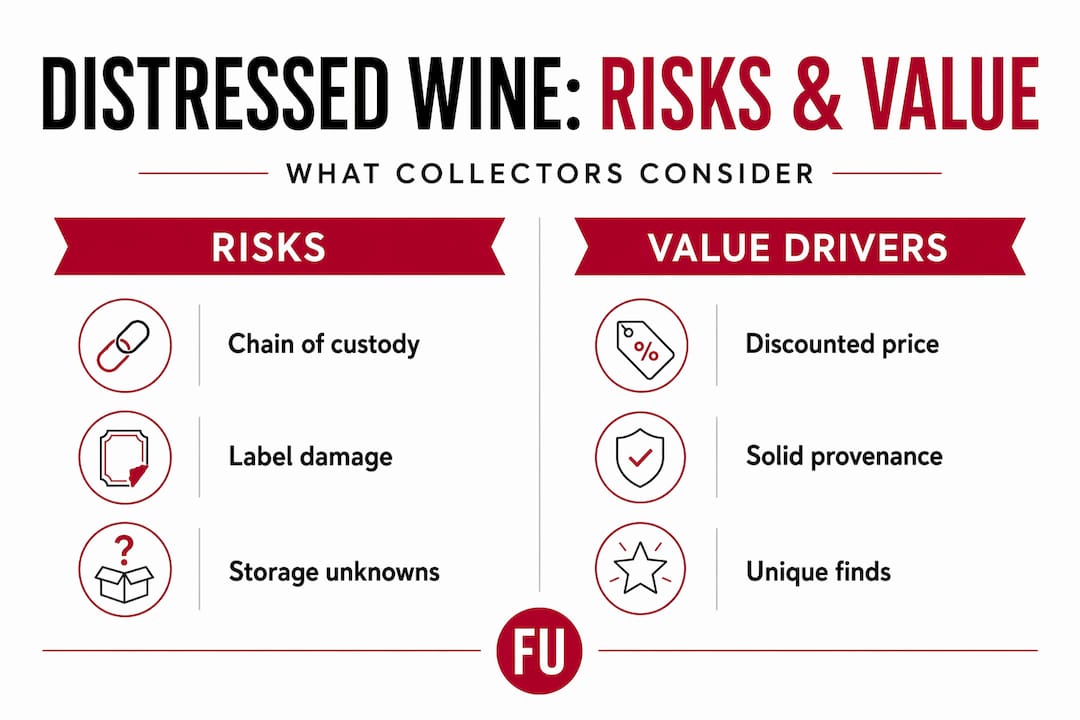
Physical condition is the first filter. Provenance and storage documentation critically shape how much a distressed bottle is actually worth. A wine that travelled poorly, sat in an uncooled warehouse for two summers, or changed hands multiple times without records can look fine on the outside while being irreparably compromised inside.
Here’s a practical process for evaluating distressed wine before you commit:
- Inspect the bottle physically. Check label condition, fill level (ullage), capsule integrity, and cork appearance if visible. Any seepage around the closure is a serious red flag.
- Request the provenance chain. Ask where the wine has been stored, by whom, and for how long. If the seller can’t tell you, price that uncertainty into your offer.
- Cross-reference market data. Compare the discounted price against recent auction results and current retail for the same vintage. A 60% discount sounds extraordinary until you discover the wine has been trading at 30% below that for a year already.
- Negotiate on known risks. If there are obvious condition concerns, missing documentation, or unusual storage history, those are legitimate grounds to negotiate the price further downward.
Pro Tip: A slightly damaged label on a well-provenance, perfectly stored bottle can work in your favour. It signals distress on paper while the wine inside is completely sound. Some of the best deals in the market look imperfect on the outside.
These same principles underpin solid wine investment strategy. Distressed wine is not automatically bad wine. It’s wine whose paperwork, packaging, or market timing has created doubt, and doubt creates discounts.
How wine destocking firms operate and what collectors should know
Between the producer who needs cash and the collector who wants a deal, there’s usually a specialist intermediary. Destocking firms like Approstock and Stic Wines evaluate excess wine, negotiate bulk purchase prices, handle logistics and relabelling, and distribute through discount retailers, absorbing the risk that producers want to avoid.
Here’s how the traditional retail channel compares to the destocking channel:
| Factor | Traditional retail | Destocking channel |
|---|---|---|
| Pricing | Full RRP or minor discount | 30 to 70% below RRP |
| Provenance transparency | High | Variable |
| Availability | Consistent, planned | Opportunistic, time-limited |
| Brand presentation | Full producer branding | Sometimes relabelled |
| Buyer profile | Casual consumers and gift buyers | Savvy collectors and trade buyers |
| Volume flexibility | Case by case | Often bulk purchase favoured |
The relabelling practice is worth understanding in detail. Producers sometimes require that their brand name not appear on deeply discounted bottles, to protect retail relationships and pricing integrity. The wine is identical, but the label is generic or altered. For collectors who know what they’re looking for, this is irrelevant. For buyers who don’t do their homework, it can create confusion.
Destocking firms also perform a genuine service for the market. They provide liquidity at moments of stress, free up cellar space for the next vintage, and ensure that good wine reaches drinkers rather than being destroyed.
Key things to know when buying through destocking channels:
- Verify the vintage and producer before purchasing, regardless of how the bottle is labelled
- Ask whether the wine has been through temperature-controlled logistics throughout the supply chain
- Understand that some wine discount strategies require moving quickly because stock is finite and won’t be replenished
Pro Tip: When a destocking offer looks almost too good, ask specifically about the reason for the discount. “Excess production” and “storage issue” are very different answers with very different implications for what’s in the bottle.
Practical tips for collectors navigating distressed wine inventory
Knowing what distressed wine inventory is and how it gets to market is one thing. Buying it well is another. Here’s how smart collectors approach it.
Buy for your actual palate and lifestyle rather than chasing categories that seem fashionable or prestigious. The biggest wine inventory issues collectors create for themselves involve purchasing wine they don’t enjoy drinking, simply because the deal looked compelling. A cellar full of aged Nebbiolo at 60% off is only valuable if you genuinely love Nebbiolo.
Practical guidelines for buying distressed wine with confidence:
- Match your climate. If you don’t have climate-controlled storage, avoid fragile wines that need precise conditions, regardless of how good the price is.
- Diversify across styles and regions. A broad cellar hedges against taste shifts and gives you drinking options for every occasion.
- Prioritise drinking over collecting. Distressed wine often signals a category in transition. Buy to enjoy, not to speculate on future appreciation.
- Use a physical checklist. Labels, ullage, cork or closure condition, sediment levels, and capsule integrity should all be assessed before any purchase.
Pro Tip: Always balance the headline discount against the actual total cost. Add in your storage costs, any transport risks, and the opportunity cost of capital tied up in wine you might not drink for years. The real deal might be a smaller discount on a wine you’ll actually open next month.
Building a versatile wine portfolio means thinking beyond price. Distressed inventory is a brilliant tool for collectors who use it strategically, not as a default buying mode.
Rethinking distressed wine inventory: a collector’s fresh perspective
Here’s the uncomfortable truth. Most collectors dramatically underestimate the impact of chain-of-custody on distressed wine. They see the discount and assume the risk is purely about market timing. It’s not.
A bottle of premium Pinot Noir that spent six months in an unregulated warehouse before being offloaded through a broker has been irreversibly changed by that experience, even if it looks pristine in the bottle. Temperature excursions above 25°C age wine rapidly and unpredictably. Vibration during long transport breaks down structure. These aren’t hypothetical risks. They’re common realities in distressed inventory supply chains that don’t have the same handling standards as premium retail.
Understanding wine inventory distress properly means recognising that the physical journey of the wine matters as much as what’s in it. The collector who asks “where has this bottle been?” is asking a more important question than “what score did it get?”
There’s also a cultural dimension worth naming. The current wave of distressed wine on the market reflects a broader shift in how people drink. Younger consumers are drinking less wine overall, drinking more categories, and rejecting the reverence that once surrounded expensive bottles. That’s not a temporary blip. It’s a structural change. The wine scarcity guide for 2026 shows where genuine scarcity still commands price premiums, and it’s a much narrower band of producers and regions than it was a decade ago.
The wisest collectors we’ve seen treat distressed inventory as a dynamic tool. They use it to fill gaps in their cellar, experiment with regions they wouldn’t pay full price to explore, and drink better at the table every week. They’re not hoarders chasing bargains. They’re pragmatists who understand that a wine collection exists to be enjoyed, not preserved indefinitely in hope of future value.
Every distressed bottle is a small rebellion against the idea that wine has to be precious to be worthwhile. Drink it. Share it. Repeat.
Discover premium wines and discounts with FU Wine
You’ve done the hard work. You understand what distressed wine inventory is, how it gets to market, and how to evaluate it like a pro. Now it’s time to put that knowledge to work.
FU Wine sources premium, hard-to-find bottles directly, with full provenance transparency and no inflated margins baked into the price. From limited releases to cellar-aged gems, every drop in the FU Wine store is there because it’s genuinely worth your time and money, not because it fills a catalogue.
- Direct purchasing with clear provenance on every bottle
- Premium wines at 30 to 70% below traditional retail
- Expert guidance tailored to collectors who know what they want
- Rotating stock that rewards the quick and the curious
Life’s too short for ordinary wine. FU Wine winks at pretension and pours you something worth talking about.
Frequently asked questions
What does distressed wine inventory mean?
Distressed wine inventory refers to wines that producers or distributors sell at discounted prices due to excess stock, market changes, or storage challenges. As seen with French surplus stocks, overproduction and market pressures are common triggers.
Why do some premium wines end up discounted in the market?
Premium wines may be discounted due to excess supply, shifting consumer tastes, or the need to clear cellar space and reduce holding costs. The US wine market glut from shifting consumer trends is a clear example of how quickly imbalance builds.
How can collectors evaluate the quality and value of distressed wines?
Collectors should assess physical condition, verify provenance documentation, compare recent market prices, and account for storage history before purchasing. Physical condition and provenance are the two factors that most directly impact what a distressed bottle is actually worth.
What role do wine destocking firms play in distressed inventory sales?
Destocking firms act as intermediaries that buy unsold wine from producers, manage logistics and relabelling, and sell through discount outlets while absorbing risk and protecting producer brands. These specialists provide a critical liquidity function that keeps the market moving during periods of oversupply.
How can collectors avoid common pitfalls when buying distressed wine?
Prioritise wines that match your tastes and storage conditions, always verify provenance, check bottles physically for defects, and treat unusually deep discounts as a prompt to ask more questions rather than move faster. Buying for your food, climate, and evolving palate is the single best discipline a collector can build.