

Drink, hold, or sell? Your wine decision guide
Most premium bottles in Australian cellars right now fall into one of three clear camps: drink within the next two years, hold for five or more, or sell while the market is warm. The fastest way to work out which camp yours belongs to is a three-question quick test.
Ask yourself: Does this wine have the structure to keep improving (acidity, tannin, balance)? Is the storage history documented and cold? And is there a liquid market for it right now? Two or more “no” answers means drink or sell. All three “yes” answers means hold.
- Drink now if the bottle is at or near its peak, storage is uncertain, or you simply want to enjoy it. Risk: none, reward is immediate.
- Hold if structure is strong, provenance is documented, and the drinking window is still years away. Risk: storage cost and potential decline if you misjudge the window.
- Sell if the market is hot, the bottle is approaching peak, and you have the paperwork to prove it. Risk: leaving future upside on the table if the wine keeps climbing.
Evaluating wine for drinking versus holding is not a mystical art. It is a repeatable checklist, and the rest of this guide walks you through it.
Key takeaways
The single most important test when evaluating wine for drinking versus holding is provenance: documented cold storage and a clean chain of custody determine both drinking quality and resale value more reliably than age alone.
| Point | Details |
|---|---|
| Structure drives ageability | Acidity, tannin, and balance determine whether a wine improves or simply fades over time. |
| Provenance is worth money | Documented storage and purchase invoices materially lift auction realisations for the same bottle. |
| Sell at or near peak | Resale demand is strongest when a wine is entering its drinking window, not after it has passed. |
| Test one, calibrate the rest | Opening a single bottle from a case gives you real intelligence on the condition of the whole holding. |
| FU Wine for appraisal and sale | FU Wine offers straight-talking appraisal advice and sale pathways for documented cellar-aged bottles. |
Table of Contents
- 1. Which structural traits make a wine worth cellaring?
- 2. Provenance and bottle condition: the single biggest practical factor
- 3. How to estimate the drinking window before you open anything
- 4. Market and financial factors: when selling beats holding
- 5. A compact decision framework you can use right now
- 6. How to check one bottle without risking the rest
- 7. How wine market trends should shape your timing decision
- 8. How to spot a counterfeit in a collectible bottle
- 9. Legal and logistical steps when you sell collectible wine in Australia
- What FU Wine has learned from splitting drinking stock and resale stock
- FU Wine can help you decide what to do with your bottles
- Sources
1. Which structural traits make a wine worth cellaring?
Age-worthy wines share structure and balance — acidity, tannin, phenolics, and sometimes residual sugar or oak-derived compounds — which create a runway for improvement over five to thirty-plus years depending on style. “Structure” in practical terms means the wine has enough natural preservatives to slow oxidation and allow complexity to build rather than fruit to simply fade.
Traits that signal genuine cellaring potential:
- High natural acidity (Hunter Valley Semillon, Riesling, Chablis-style Chardonnay)
- Firm, grippy tannin that still needs time to integrate (Cabernet Sauvignon, Barolo, Shiraz)
- Balanced alcohol — not so high it bakes the fruit, not so low it leaves the wine thin
- Residual sugar acting as a preservative (late-harvest Riesling, Sauternes)
- Phenolic density from oak or skin contact
Typical style runways: structured Cabernet and Shiraz from premium Australian regions often peak after several years; Hunter Semillon can last longer; fortifieds have very extended aging potential. Pinot Noir and Chardonnay tend to have a shorter aging window, generally several years for top examples.
Red flags that mean a wine is unlikely to improve:
- Thin, watery acidity on the palate
- Low tannin with no grip or backbone
- Volatile acidity (vinegar-like lift on the nose)
- Poor balance — one element dominating without support
Pro Tip: You do not need to open the bottle to check balance. Pull the vintage notes and producer track record from FU Wine’s vintage explainer and cross-reference with Halliday scores. A wine from a weak vintage with a producer known for early-drinking styles is almost never a cellar candidate, no matter how old it is.
2. Provenance and bottle condition: the single biggest practical factor
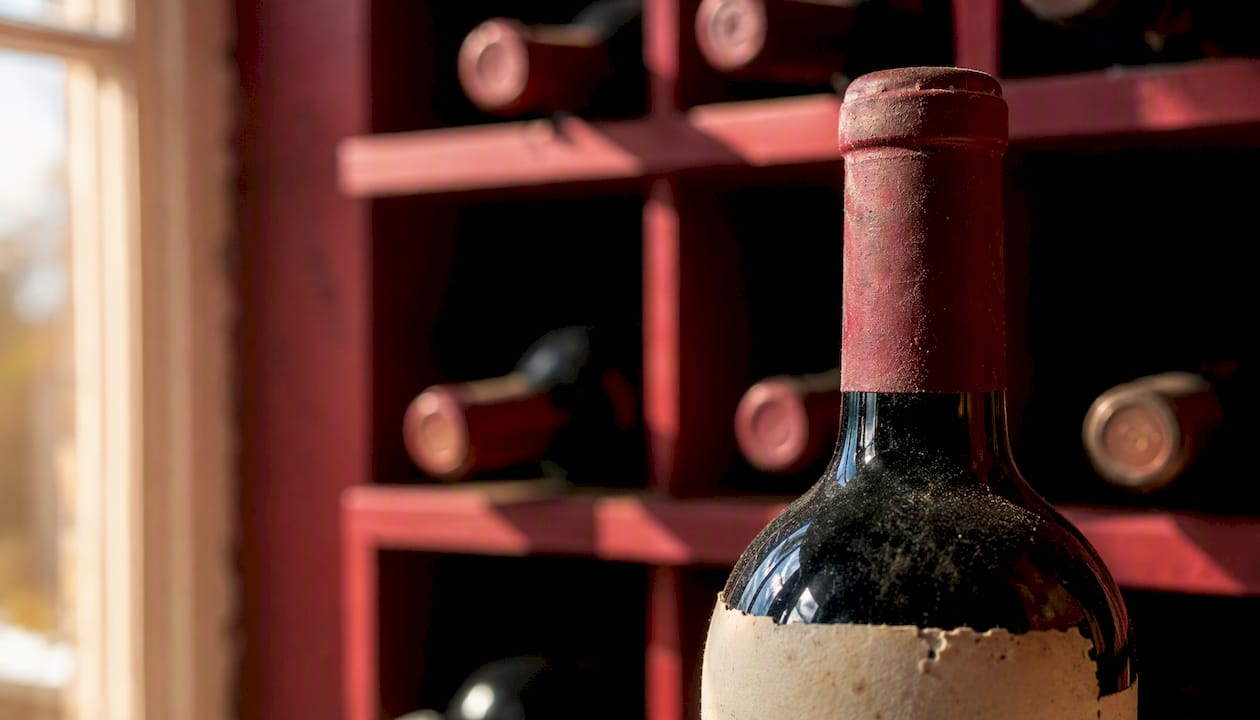
Documented provenance is the difference between a bottle worth its asking price and a gamble. Stable, cool storage around 12–14°C, moderate humidity, and minimal light and vibration materially slow deterioration and help wine reach its peak. Even short-term poor storage — a hot garage, a shipping container in summer — can shorten a bottle’s usable window by years.
What documented provenance looks like:
- Original purchase invoice with date and retailer
- Bonded cellarage receipts showing temperature logs
- Continuous chain of custody (no gaps between owners)
- Professional storage facility records
Physical bottle inspection checklist:
- Ullage (fill level): The gap between the wine and the cork. Low fill in a young wine is a red flag; some ullage in a very old bottle is normal.
- Cork condition: Any seepage, staining, or mould on the capsule suggests the seal has been compromised.
- Label and capsule: Faded, water-damaged, or torn labels reduce resale value and may indicate poor storage.
- Back label and lot code: Confirms authenticity and production batch.
- Bottle swirls or sediment: Normal in aged reds; excessive cloudiness in a white is a warning sign.
- Signs of re-corking or tampering: Mismatched capsule, uneven cork depth, or a capsule that spins freely.
For home inspection, photograph the fill level against a light source, the capsule top-down, and both labels. If you are preparing bottles for sale, a professional appraiser can provide written condition reports that materially lift buyer confidence at auction.
3. How to estimate the drinking window before you open anything
A wine’s drinking window varies by style, vintage, and storage; documented cellarage and tracking increase confidence about when to open or offer a bottle for sale. The window is the sweet spot between “not yet ready” and “past its best.”
Signs a wine is approaching or at peak:
- Colour shifting from deep purple to garnet or brick at the rim (reds)
- Tertiary aromas emerging: leather, earth, dried fruit, tobacco, mushroom
- Tannins softening and integrating rather than gripping
- Fruit intensity still present but more savoury and complex
Signs a wine has passed its peak:
- Flat, muted fruit with no lift
- Brittle or hollow mid-palate
- Oxidised, sherry-like character (unless it is a fortified)
- Colour browning significantly beyond the rim
Style-by-style timing guide:
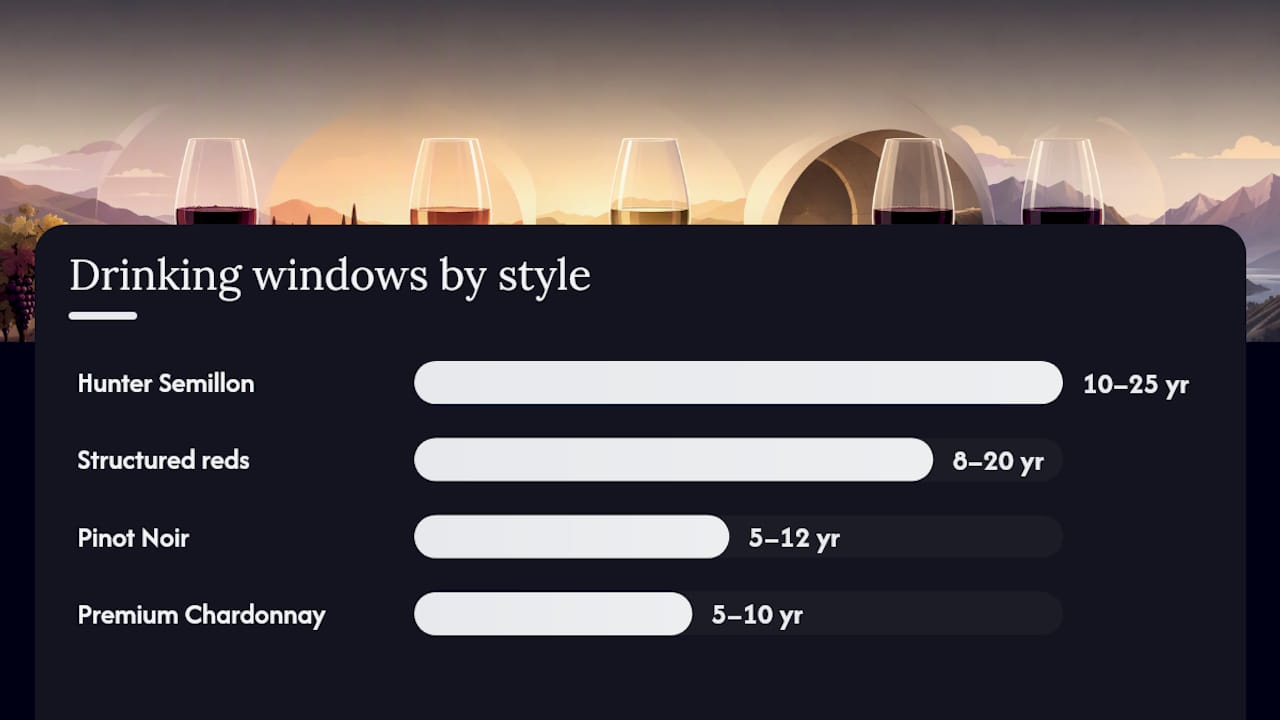
- Structured reds (Cabernet, Shiraz, Barolo): 8–20 years from vintage
- Pinot Noir: 5–12 years
- Premium Chardonnay: 5–10 years
- Hunter Semillon: 10–25 years
- Riesling: 8–20 years
- Fortifieds: decades, often indefinite
Screwcap closures slow development compared to cork, so personal preference and the balance between declining fruit and rising complexity should guide the call. Magnums develop more slowly than standard bottles; half-bottles faster.
Pro Tip: If you own a case of twelve, open one bottle at the seven-year mark as a test drink. That single sacrifice calibrates the rest of the holding far more accurately than any tasting note written by someone else.
4. Market and financial factors: when selling beats holding
Scarcity and provenance underpin fine-wine pricing, and resale demand is strongest when a wine is entering or sitting within its optimal drinking window, not merely because it is old. Age alone does not create value.
Market factors to weigh:
- Recent auction comparables (Langtons and other Australian auction houses publish realised prices)
- Producer and vintage reputation — is this a celebrated year or a soft one?
- Remaining supply in the market — scarcity drives premiums
- Timing relative to the drinking window — selling just before peak often captures the highest price
A simple hold-versus-sell cost check: Annual bonded storage typically incurs a modest cost per case in Australia, plus insurance. Add opportunity cost on the capital tied up. If the bottle is not appreciating faster than those combined costs, selling now is the rational move.
For investment-grade bottles, producer pedigree, scarcity, and provenance are the primary drivers of resale value; attempting to time the market on off-vintages is risky. Langtons and auction specialists consistently note that poor storage documentation can wipe out scarcity premiums entirely.
Trigger events that favour selling now:
- The market is hot and comparable bottles are achieving strong results
- The wine is approaching peak with limited buyer liquidity in that style
- Storage costs are rising relative to the bottle’s likely appreciation
- You need the capital for something else
5. A compact decision framework you can use right now
Run every bottle through this sequence before making a call.
- Check provenance. Do you have an invoice, storage logs, or bonded cellarage receipts? Two or more gaps in the chain of custody = sell or drink, do not hold.
- Assess structure. Does the vintage and producer profile suggest genuine ageability? No = drink now or sell.
- Read the bottle. Inspect ullage, capsule, labels, and cork condition. Any red flags = adjust price expectations or drink.
- Estimate the window. Is the wine still years from peak, at peak, or past it? Past peak = drink immediately. At peak with strong market = sell.
- Calculate holding cost. Storage, insurance, and opportunity cost versus likely price appreciation. If the numbers do not stack up = sell.
Decision thresholds: Two or more provenance red flags means sell or inspect professionally before deciding. Strong ageability plus documented cold storage means hold. At peak plus a liquid market means sell now and capture the premium.
Separating drinking stock from resale stock keeps your decision-making clean. Mixing the two erodes discipline fast.
Pro Tip: If you own multiples, monetise a portion and keep the rest. Selling three bottles from a case of twelve funds the storage cost of the remaining nine and removes the financial pressure to sell everything at once. See how to build a wine portfolio for a practical split strategy.
6. How to check one bottle without risking the rest
You do not need to open everything to know what you have.
- Withdraw one bottle from a case and open it as a test drink. The condition of that bottle tells you what the rest are likely doing.
- Commission a professional appraisal. A reputable appraiser can assess condition, authenticity, and market value from physical inspection and photographs without opening anything.
- Use photographic evidence. High-resolution images of fill level, capsule, labels, and lot codes are often sufficient for auction house pre-assessment.
- Request bonded cellarage retrieval. If your wine is in professional storage, ask the facility for a condition report before committing to a sale or a drink.
- Lab-backed provenance checks exist for ultra-high-value bottles but are rarely needed for commercial resale at standard collector price points.
For most Australian collectors, a professional appraisal plus a single test bottle from the case is all the intelligence you need to make a confident call.
7. How wine market trends should shape your timing decision
The Australian fine-wine market moves in cycles tied to global demand, currency shifts, and the release of critical scores. Broadly, structured Australian reds — particularly Barossa Shiraz, Coonawarra Cabernet, and Clare Valley Riesling — have maintained strong collector interest, while some international styles have softened as the Australian dollar fluctuates.
Forecasted trends worth watching: growing Asian collector demand for top Australian producers continues to support premium pricing on well-documented bottles. Secondary market platforms and auction houses have expanded their reach, meaning liquidity for the right bottle is better than it was a decade ago. However, bottles without clean provenance are increasingly discounted as buyers become more sophisticated.
The practical takeaway: if you hold a bottle from a celebrated Australian vintage with full documentation, the market window is favourable. If the bottle is from a softer year or lacks paperwork, the gap between what you hope to achieve and what the market will pay is widening, not narrowing. Check wine investment factors for current producer and vintage signals before deciding.
8. How to spot a counterfeit in a collectible bottle
Counterfeiting is a real risk at the top end of the market. The most common targets are trophy bottles: Penfolds Grange, Hill of Grace, and internationally, first-growth Bordeaux.
Authenticity checks you can do yourself:
- Compare the label typography, font weight, and colour against verified reference images from the producer or a trusted auction catalogue.
- Check the lot code and back label against the producer’s own records — many Australian producers will verify authenticity on request.
- Examine the capsule for consistent crimping and the correct foil weight and colour for the vintage.
- Look at the cork through the base of the bottle using a torch — the producer name and vintage should be legible on a genuine cork.
- Cross-reference the bottle shape and glass weight against known genuine examples.
For bottles above $1,000, a professional authentication service or auction house pre-sale inspection is worth the cost. Langtons and other reputable Australian auction houses conduct physical inspections as part of their consignment process, which provides a layer of third-party verification that protects both seller and buyer.
9. Legal and logistical steps when you sell collectible wine in Australia
Selling wine privately or through auction in Australia carries obligations most collectors underestimate.
Documentation you need:
- Original purchase invoice or proof of ownership
- Storage records showing chain of custody
- Any existing appraisal or condition reports
Sales channels available in Australia:
- Auction houses (Langtons and similar): highest price potential for trophy bottles, fees typically 10–15% of the hammer price, and they handle authentication and buyer reach.
- Private sale: faster and fee-free, but you carry all authentication and legal risk.
- Online specialist platforms: growing in Australia, with varying fee structures and buyer verification standards.
Legal considerations: In Australia, selling alcohol privately without a licence is restricted. Selling through a licensed auction house or retailer sidesteps this issue cleanly. If you are selling regularly or in volume, consult a tax adviser — proceeds from wine sales may be assessable income or subject to capital gains tax depending on your circumstances and whether the wine was held as a personal use asset or an investment. This is general information; confirm your specific position with a qualified tax professional.
What FU Wine has learned from splitting drinking stock and resale stock
Every bottle tells you something. The ones we drink teach us where the window actually sits; the ones we sell teach us what the market will actually pay. Those are two very different lessons, and conflating them is where most collectors go wrong.
At FU Wine, the heuristic is simple: buy in cases where possible, schedule a tasting bottle at the midpoint of the expected window, and keep provenance records from day one. Not because it is bureaucratic, but because a clean invoice and a storage log are worth real money at auction. We have seen identical bottles from the same vintage achieve materially different prices based on paperwork alone.
The conflict of interest is worth naming directly. FU Wine sources and sells cellar-aged stock, so we have a commercial interest in you buying from us. But we also think life is too short to hold a bottle past its peak waiting for a price that never comes. The honest advice is: drink what you love when it is ready, sell what the market wants while it wants it, and hold only what genuinely has years of upside left. Every bottle is a small rebellion against the idea that wine is too precious to enjoy.
FU Wine can help you decide what to do with your bottles
You have done the reading. Now you need a verdict on the actual bottles in your cellar. FU Wine works with collectors at every stage — from a quick appraisal of what you have, through to storage options and sale pathways that get your bottles in front of serious buyers.
To get started, pull together your purchase invoices, storage records, and a photo of each bottle’s fill level and capsule, then consider wine pairing on a charter yacht to elevate your tasting experience. FU Wine’s team can assess condition, give you a realistic market read, and outline your options — drink, hold, or sell — without the usual gatekeeping and inflated fees. No pretension, no runaround. Just a straight answer on what your wine is worth and what to do next.
Browse premium cellar-aged bottles or head straight to Fuwine to start the conversation.
Sources
Before you make a call on any bottle, photograph the fill level, capsule, and both labels. Document your storage history in writing. Then reach out with case-level details.
- When should I drink this wine? | Halliday Wine Companion
- Review of bottle aging and storage conditions — MDPI (2021)
- Wine drinking windows: how long can you store wine - Wine Ark
- Collecting age-worthy wine | Wine Folly
This article is general information, not a substitute for advice from a qualified financial advisor. Consult a qualified financial professional about your own circumstances before acting on anything here.