

Secure Corporate Wine for Q4 in Australia With a House Account
The fastest way to secure personalised corporate wine at scale is to work with a specialist corporate wine partner who handles sourcing, custom labelling and Australia-wide delivery under one brief. Expect minimum orders that scale with your label complexity, and lead times that stretch out hard around EOFY and Christmas. Your first move: send a scoping brief and request a quote and sample. Final price hinges entirely on the wine quality, label finish and packaging you choose.
TL;DR:
- Minimum orders for custom labels depend on complexity and may require larger volumes, especially for fully private-label programs or bulk sourcing.
- Accurate quotes require detailed briefs covering volume, wine style, packaging, technical specs, and budget targets before discussions begin.
- Shipping Australia-wide involves managing heat risks with cooled transport, early booking, and confirming insurance and claims procedures beforehand.
- Suppliers with flexible sample policies, clear documentation, and guaranteed lead times are essential, particularly during peak seasons like December.
- Using a house-account model can reserve seasonal capacity and ensure consistent delivery for high-volume, year-round corporate gifting programs.
Table of Contents
- What to scope before you request quotes
- Pricing, minimums and ordering models for corporate purchases
- Custom labels, packaging and gifting that land well
- Logistics and compliance for Australia-wide corporate deliveries
- How to choose a partner: selection criteria and the house-account model
- Publisher perspective: how FU Wine approaches corporate orders
- Get a quote from FU Wine
- Sources
- FAQ
What to scope before you request quotes
Suppliers can only quote accurately when you hand them a proper brief, not a vague “we need wine for clients” email. Treat it like any procurement job: specifics in, accurate numbers out.
Get these details locked down before you pick up the phone:
- Volume and cadence. Total bottles or cases needed, and whether this is a one-off run or a recurring quarterly order.
- Wine style and positioning. Are you after crowd-pleasing reds and whites, or something with cellar cred that signals “we take this seriously”?
- Packaging and personalisation. Single bottles, boxed sets, hampers, or fully customised labels with your logo and a client’s name.
- Technical specifications. For bulk or private-label orders, you need agreed limits on pH, alcohol percentage and sulphur, with written specifications and technical sign-off before anything ships.
- Budget per unit. Work out your landed cost target including freight and GST, not just the sticker price on the wine itself.
Skip any of this and you’ll get a quote that means nothing once freight, packaging and label print get added on top.
Pricing, minimums and ordering models for corporate purchases
Corporate wine pricing runs on two different tracks, and mixing them up is where budgets blow out.
Bottle-level buying works on per-bottle or per-dozen pricing, with volume discounts kicking in as case counts grow. Bulk sourcing works in litres, usually via ISO tanks, flexitanks or IBCs, and it’s priced and negotiated on technical parameters like alcohol content and sulphur levels rather than label art.
Minimum order quantities vary depending on requirements:
- Finished bottled stock with a simple sticker label often begins at small case quantities.
- Fully custom label runs typically require larger minimums due to print setup costs.
- Bulk private-label programs generally require substantial volumes to justify costs.
A low ex-cellar price rarely means the lowest delivered cost. Once you add freight, testing, bottling and packaging, a cheaper bulk quote can land more expensive than a finished-stock option. Always ask for the full landed cost, not the headline litre price.
Your invoice should break down wine cost, label design and print, packaging, freight, insurance and GST as separate lines. If a supplier bundles it all into one number, ask why.
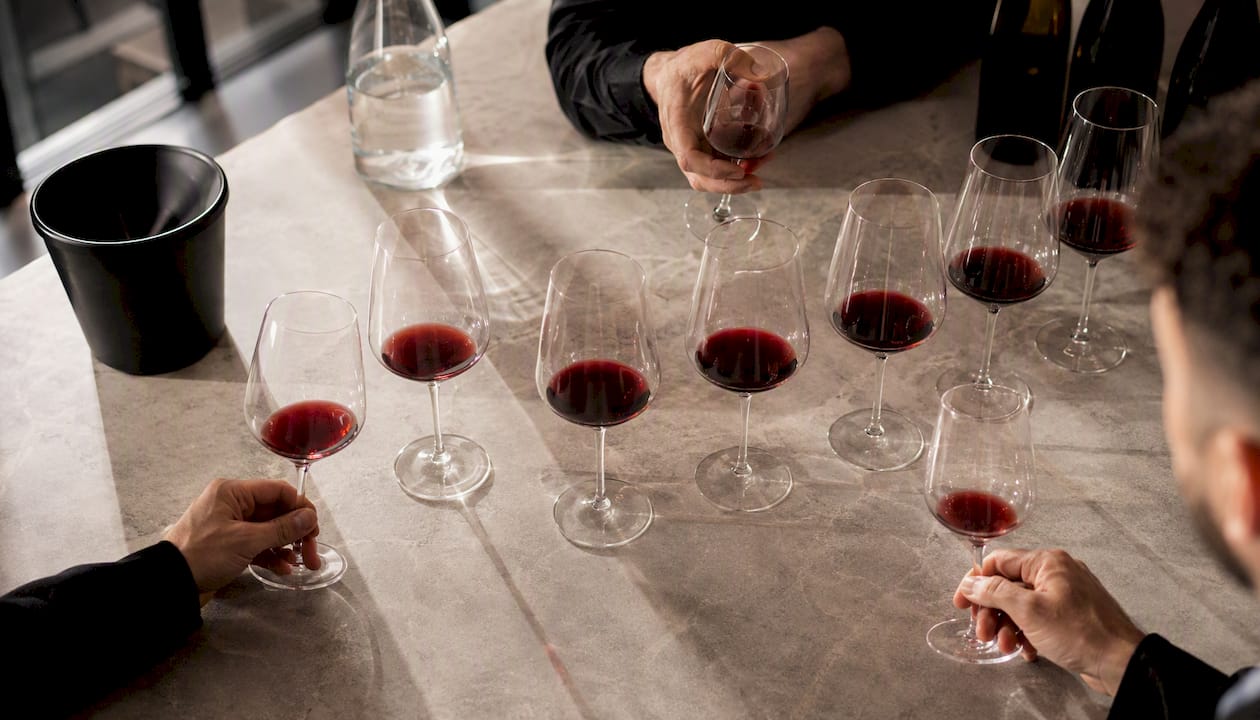
Sample tasting rounds add time and cost, but skipping them is how companies end up gifting a wine that tastes nothing like what they approved.
Custom labels, packaging and gifting that land well
A personalised label is the whole point of corporate wine gifting, but Australian labelling rules aren’t optional extras. Every label needs country of origin, alcohol by volume, and the standard health warning, regardless of how much custom branding sits around them.
Here’s how the process typically runs:
- Design and proof. You submit artwork, the supplier proofs it against label regulations and print specs, and you sign off before a single bottle gets labelled.
- Choose your run type. A single-template label (your logo, one message, applied to the whole batch) is cheaper and faster than variable-data labelling, where each bottle carries a different name or message and costs more, with a longer lead time.
- Lock in packaging. Presentation boxes, cylinders and full hampers all carry different price points and different production windows, so decide early.
- Confirm fulfilment logistics. If you’re shipping to fifty different client addresses instead of one warehouse, say so upfront. This changes tracking and packing complexity significantly.
Pro Tip: Lock your label artwork before your final vintage is confirmed, and ask your supplier how they handle a vintage change mid production. A locked label with a shifted vintage on the bottle is a common, avoidable headache.
Logistics and compliance for Australia-wide corporate deliveries
Wine is fragile cargo, and Australia’s climate doesn’t do it any favours. Heat is the biggest threat to a corporate order arriving in the state it left the warehouse.
- Carrier choice matters more than most buyers realise. Transport at controlled cool temperatures where possible, with deliveries scheduled to avoid the middle of the day, meaningfully cuts heat damage risk.
- Insulated packaging and early morning delivery windows are standard countermeasures during summer runs.
- Alcohol delivery in Australia requires age verification at the point of receipt. An adult over 18 needs to sign for the delivery, which matters when you’re shipping to a reception desk rather than a named individual.
- Peak season (Q4 through Christmas, and again around EOFY) stretches lead times considerably. Book your slot early or risk missing the date entirely.
- If you’re sourcing from overseas, import documentation and customs clearance sit with the supplier. Confirm this paperwork is genuinely handled before you commit, not assumed.
Cold-chain failures are rarely dramatic. They’re a pallet sitting on a loading dock in February heat for four hours. Ask your supplier exactly how they prevent that.
Keep a retained reference sample from every batch, and confirm the insurance and claims process before anything ships, not after something arrives cooked.
How to choose a partner: selection criteria and the house-account model
Not every wine seller is set up for corporate work, and the gap shows up fast once you’re managing fifty addresses instead of five.
Run potential partners through this checklist:
- Sample and proofing policy. Will they send a physical sample linked to your actual batch, or a generic “similar wine” sample?
- MOQ flexibility. Can they scale from a fifty bottle trial to a five hundred bottle rollout without a total repricing?
- Fulfilment capacity. Can they handle multi-address shipping with individual tracking, or only bulk-to-one-dock delivery?
- Documentation. Do they provide written specifications, insurance details and clear invoicing breakdowns without you having to chase them?
- Payment terms. Deposit structure, balance timing, and accepted payment methods should be clear before you sign anything.
Ask directly: what’s your guaranteed lead time in December? What happens if a batch fails a spec check? Can you fulfil three hundred individually addressed parcels by a fixed date?
A retained house account solves a real problem for companies that gift year-round, reserving seasonal capacity and giving you consistent curation instead of scrambling every quarter. Bulk private-label programs make sense for high-volume, cost-sensitive gifting; buying finished bottled stock suits smaller runs or premium positioning where quality matters more than unit cost.
Pro Tip: If a supplier won’t commit to a written lead-time guarantee for peak season, treat that as your biggest red flag, not a minor gap.
Publisher perspective: how FU Wine approaches corporate orders
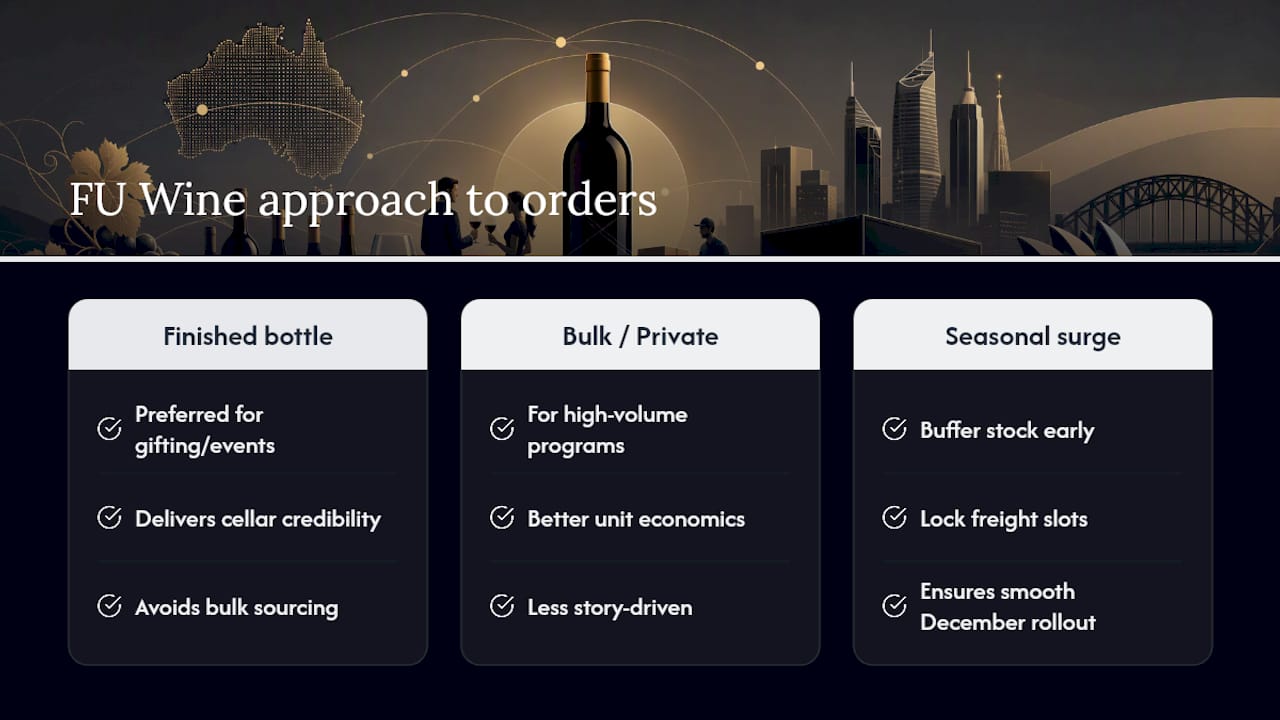
A deal-driven catalogue changes the maths on corporate gifting. Buying premium, hard-to-find bottles at a discount means you can gift something with genuine cellar credibility without blowing the per-unit budget on markup.
We generally point buyers toward finished-bottle purchases for gifting and events, and save bulk or private-label sourcing for companies running high-volume programs where unit economics matter more than story. Seasonal surges are the real test. Buffering stock and locking freight slots early is what separates a smooth December rollout from a scramble.
— Damien
Get a quote from FU Wine
An alternative to paying inflated retail markup on corporate wine is to work with suppliers who source premium and hard-to-find bottles, while also handling custom labelling, sample approvals and Australia-wide fulfilment.
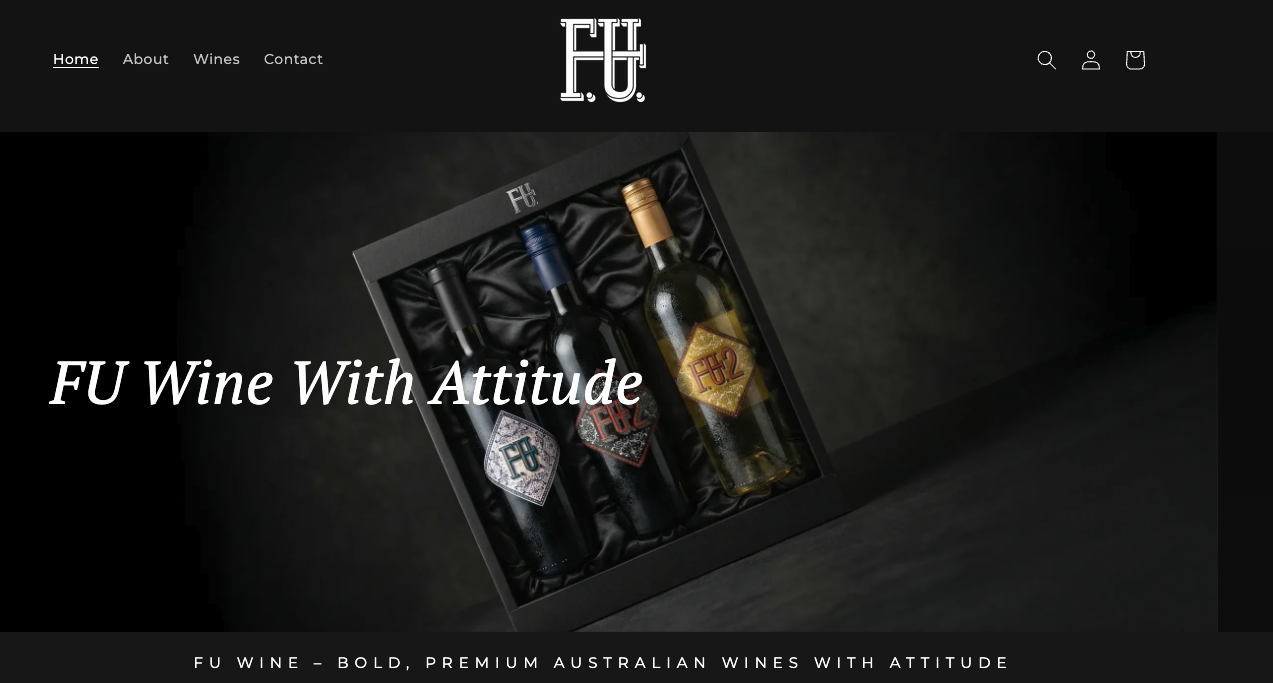
No pretentious sales pitch here. Send your volume, delivery windows and label brief to suppliers who can provide a quote and a sample tied to the actual batch you would be buying. If you’re building a recurring gifting calendar rather than a one-off order, ask about a house-account style arrangement so your seasonal capacity is reserved before the December rush hits.
Ready to start? Head to FU Wine’s Wines page and request your corporate quote today.
Sources
- Bulk Wine Sourcing for Bottlers and Distributors | Wine Kingdom
- Transport and storage | Australian Wine Research Institute (AWRI)
- Company wine services & the house account — Prestige Vin
FAQ
What Is the Best Website to Buy Wine in Australia for Corporate Orders?
The right choice depends on whether you need finished, gift-ready bottles or bulk private-label stock. For premium finished bottles at a discount with custom labelling and Australia-wide fulfilment, FU Wine handles corporate enquiries directly through its site.
What Is the 75-85-95 Rule for Wine?
This rule refers to serving temperature guidance rather than corporate procurement, and specific definitions vary between sources, so it’s worth confirming with a wine professional before applying it to your event planning.
Can I Buy Wine Direct From a Producer?
Yes, many Australian producers sell direct, though corporate buyers usually find better efficiency working through a partner who consolidates sourcing, labelling and delivery under one brief rather than negotiating with multiple wineries separately.
Is Australia Facing a Wine Oversupply?
The Australian wine sector has dealt with oversupply pressures in recent years, particularly in bulk red wine, which has made competitively priced premium and cellar-aged stock more available to buyers who know where to look.
How Far in Advance Should I Order Corporate Wine for Christmas?
Book your slot well before Q4 given how tight peak-season lead times get; suppliers processing custom labels and multi-address fulfilment need extra runway during the December rush.