

How to identify collectible bottles: a wine collector's guide
TL;DR:
- Careful examination of physical features like seams, pontil marks, embossing, and color helps identify collectible bottles accurately. Condition and rarity significantly influence a bottle’s value, with unique colors and provenance driving premium prices. Combining visual inspection with cross-referenced guides enhances confidence in dating and valuing antique bottles correctly.
You pick up a dusty bottle at a market and something about it feels different. The glass has a slight violet tint. The seam stops before the lip. There’s embossing you don’t recognise. Knowing how to identify collectible bottles at that moment is the difference between a $10 impulse buy and a $10,000 find. This guide cuts through the guesswork and gives you the forensic tools to spot valuable bottles with confidence, whether you’re building a collection, assessing wine investments, or just hunting for something genuinely rare.
Table of Contents
- Key takeaways
- How to identify collectible bottles: the key physical markers
- Step-by-step techniques for dating and examining bottles
- Evaluating condition, rarity, and value
- Integrating bottle identification into wine collecting
- My honest take on identifying collectible bottles
- Find rare bottles without the runaround
- FAQ
Key takeaways
| Point | Details |
|---|---|
| Use multiple physical markers | Seams, pontil marks, embossing, and colour together give a far more accurate picture than any single feature alone. |
| Condition directly drives value | Chips, stains, and removed labels can slash a bottle’s worth by 30 to 50 percent regardless of age or rarity. |
| Embossing is your best dating tool | Raised lettering and patent marks on bottles from the 1860s to 1920s act as a reliable origin record. |
| Rare colours command serious premiums | Cobalt blue, emerald green, and sun-purpled glass are markers of genuine scarcity and collector desirability. |
| Cross-reference everything | Databases and typology guides beat intuition every time when authenticating collectible bottles. |
How to identify collectible bottles: the key physical markers
Before you start chasing valuations, you need to understand what you’re actually looking at. Collectible bottle identification is a physical process. You’re reading the glass itself like a document.
The four features every collector should examine first are mold seams, pontil marks, lips and closures, and embossing. Together, they tell the story of when and how a bottle was made. Individually, they’re clues. Combined, they’re a verdict.
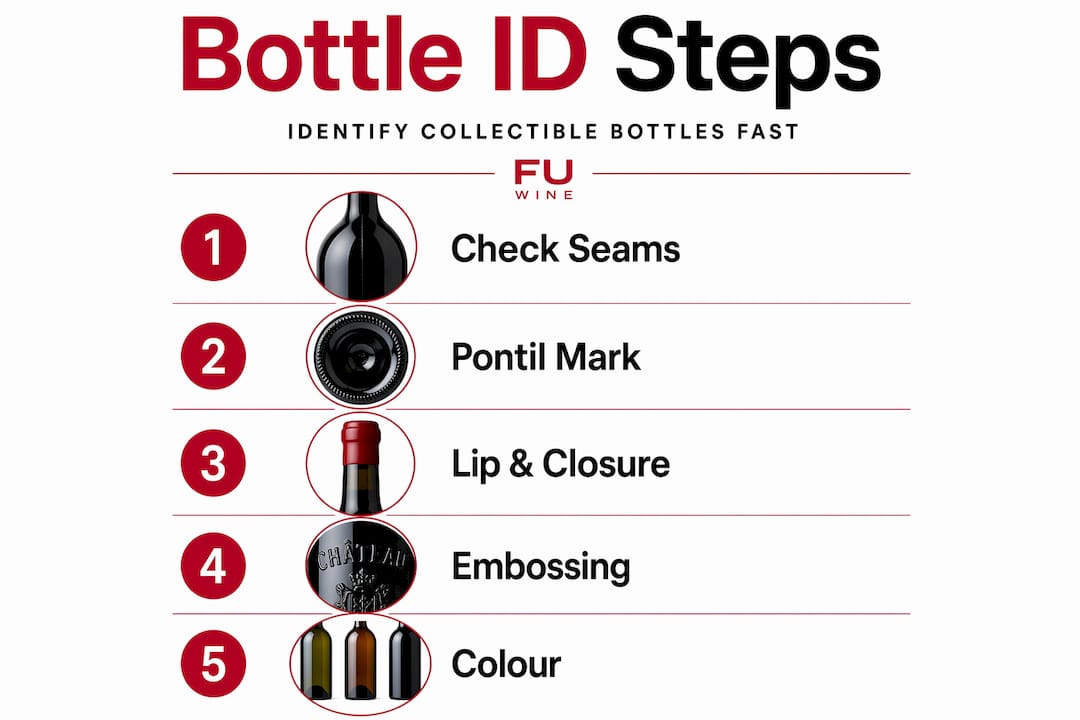
Colour is one of the fastest visual shortcuts. Cobalt blue, deep emerald green, and amber are historically significant and actively sought after by collectors. Sun-purpled glass, which is clear glass that has turned violet from prolonged UV exposure, indicates manganese dioxide content used before 1920. If you spot that violet tint, you’re looking at pre-1920 glass composition worth investigating further.
Here is a quick reference for what each physical feature signals:
| Feature | What it tells you |
|---|---|
| Mold seam stopping below lip | Hand-finished, likely 1850 to 1900 |
| Mold seam running over lip | Machine-made, post-1903 |
| Pontil mark on base | Hand-blown, typically pre-1860s |
| Embossed lettering or patent date | Manufactured 1860s to 1920s |
| Sun-purpled or violet glass | Pre-1920 manganese content |
| Cobalt blue or emerald green | Rare colour, higher collector demand |
For reference guides and maker’s mark databases, the Historic Glass Bottle Identification website is one of the most thorough free resources available. Treat it like your field manual. Pull it up when you’re unsure and cross-reference what you’re seeing against established typologies rather than gut feeling.
Pro Tip: Never over-clean a bottle before you’ve assessed it. Dust, grime, and original labels carry provenance. Removing vintage labels or scrubbing a bottle too aggressively can reduce market value by 30 to 50 percent. Less intervention is more.
When you handle a bottle, hold it up to natural light. Check the base with a torch. Run your fingers over the seam and lip. This tactile, close-up inspection takes two minutes and tells you more than any photograph.
Step-by-step techniques for dating and examining bottles
Good collectible bottle identification follows a logical sequence. Work through these steps every time you assess an unknown bottle.
-
Examine the mold seam first. The seam is your primary dating tool. Machine-made bottles after 1903 have seams running continuously over the lip. Bottles made between 1850 and 1900 show seams stopping at or just below the lip, because a glassworker finished the top by hand. Pre-1850 bottles often show irregular seams or none at all.
-
Check the base for pontil marks. A pontil mark is the rough scar left by the iron rod used to hold the bottle during hand-blowing. Pre-1860s hand-blown bottles show these marks clearly, ranging from jagged chips to smooth iron pontil scars. No pontil mark on an older-looking bottle should raise a flag.
-
Inspect the lip and closure type. Applied lips (added separately as molten glass) indicate pre-1900 manufacture. Tooled lips (shaped with tools from the bottle’s own glass) span roughly 1870 to 1910. Machine-made lips are uniform and show the seam running over the top. Each type places your bottle in a specific manufacturing window.
-
Read the embossing carefully. Embossing on bottles from the 1860s to 1920s is as close to a birth certificate as glass gets. Look for raised brand names, city names, patent dates, and manufacturer codes. A patent date doesn’t mean the bottle was made that year, but it gives you an earliest possible date of manufacture.
-
Assess colour under natural and UV light. Sun-purpled glass only occurs on bottles with manganese content, which was phased out around 1915 to 1920. Selenium-based glass from the 1920s turns amber under UV. Both are reliable age indicators that support your seam and pontil findings.
-
Cross-reference with databases and guides. Forensic, typology-based identification beats intuition consistently. Once you have your physical observations, compare them against known bottle types using the Historic Glass Bottle Identification site or specialist collector guides.
Pro Tip: Avoid the seam height myth. A lot of collectors assume a higher seam automatically means an older bottle, but that’s not always true. Combining embossing, colour, base marks, and closure types gives you a far more accurate result than seam height alone.
The process takes practise, but it becomes fast. After a dozen bottles, you’ll be running through these steps in under five minutes.
Evaluating condition, rarity, and value
Once you’ve dated and identified a bottle, the next question is what it’s actually worth. This is where collectible bottle identification overlaps directly with investment thinking.
Condition is non-negotiable. A chip on the lip, a crack in the body, or heavy staining can transform a potentially valuable bottle into a shelf curiosity. Condition issues like chips or stains can drastically reduce value regardless of rarity or age. Collectors in serious markets will pass on a rare bottle with damage before they’ll accept a discounted price on it.
Rarity works on several levels. Limited production runs matter. So do factory errors, unusual colour variants, and regional bottles that survived in small numbers. A standard antique bottle might fetch $10 to $200 at auction. The same bottle in a rare colour with exceptional condition can command tens of thousands.
Historical significance adds a layer that goes beyond the physical object. Bottles tied to notable events, famous producers, or significant eras carry provenance that drives collector demand well above their material value.
The numbers back this up. A circa 1825 Columbia/Eagle flask sold for a record $177,840 at auction in May 2026. That result wasn’t about age alone. It combined extreme rarity, pristine condition, historical iconography, and documented provenance. That combination is what serious collectors are always chasing.
“The most valuable bottles aren’t just old. They’re rare, intact, historically significant, and verifiably genuine. Miss one of those factors and the price drops fast.”
For wine collectors specifically, factors like label preservation and provenance are especially critical. An intact original label on a wine bottle from a notable vintage is not decoration. It’s documentation.
Integrating bottle identification into wine collecting

For wine collectors and enthusiasts, bottle identification skills are not just a curiosity. They’re a practical tool that sharpens your entire approach to collecting and investing.
Understanding the physical characteristics of wine bottles across different eras helps you authenticate vintage and antique wine bottles with greater confidence. An early Bordeaux-style bottle with hand-applied lip and pontil mark tells you a great deal about its production context before you even consider the label.
A few things worth knowing if you’re applying this to wine collecting specifically:
- Rare bottle colours in wine, particularly deep olive green and black glass from the 18th and 19th centuries, signal age and are associated with cellaring quality wines of that period.
- Maker’s marks and embossing on wine bottles can confirm regional origin, which matters enormously for provenance and value.
- Batch codes and brand-specific markers used by spirit producers apply similarly to premium wine labels. Anything that seems too good to be true probably warrants extra scrutiny.
- Cross-referencing your bottle findings against vintage ratings and classification guides adds context to the physical identification work you’ve already done.
- The overlap between bottle identification and wine vintage appraisal is significant. A bottle that checks out physically but lacks documented provenance is worth less than one with a traceable story.
The collectors who get the best results treat physical bottle identification and wine knowledge as complementary skills. One without the other leaves gaps. Together, they give you a genuinely informed view of what you’re holding.
My honest take on identifying collectible bottles
I developed my approach to bottle identification the hard way. I overpaid for bottles I thought were rare, passed on bottles I should have bought, and slowly realised that the collectors who consistently get it right are not guessing. They are reading glass the same way you’d read a document.
The most common mistake I see among enthusiasts is anchoring on a single feature. Someone spots a pontil mark and assumes they’ve found something extraordinary. But a pontil mark alone only tells you the bottle is pre-1860s. Without checking the colour, the seam, the embossing, and the closure type, you’re working with incomplete information.
What actually works is treating every bottle as a crime scene. You collect evidence. Seam height, base marks, lip type, glass colour, embossing, label condition. Each one confirms or challenges the others. When they all point in the same direction, you can be genuinely confident in your conclusion.
The thrill of getting it right is real. Finding a bottle that checks every box, dating it accurately, understanding its provenance, and knowing what it’s worth before anyone else in the room does. That’s the skill that separates a serious collector from someone who just buys things they like.
My practical advice: build your reference library before you build your collection. Understand the typologies. Get comfortable with the physical inspection process. And never let a price tag do your identification work for you.
— Damien
Find rare bottles without the runaround
If you’ve done the identification work and you’re ready to act on it, FU Wine is where serious collectors come to source rare and collectible bottles without paying inflated retail prices.
FU Wine brings in limited releases, high-scoring vintages, and hard-to-find bottles at prices that actually make sense for collectors. No gatekeeping, no pretension. Just rare wine sourced smart and priced honestly. Whether you’re building a cellar, hunting specific vintages, or looking for bottles with genuine collectible credentials, the FU Wine collection is worth a look. Flash deals rotate regularly, so if something catches your eye, move on it. The good stuff doesn’t sit around.
FAQ
What physical features indicate a bottle is genuinely antique?
Look for pontil marks on the base, mold seams stopping below the lip, applied or tooled lips, and embossing with patent dates or maker’s marks. Together, these features confirm hand-manufacturing methods used before 1900.
How does glass colour affect a bottle’s collectible value?
Cobalt blue, emerald green, and sun-purpled glass are rare and actively sought by collectors. Unusual colours often signal limited production or early manufacturing methods, which directly increases desirability and market value.
What is the seam height myth in bottle collecting?
Many collectors assume a seam stopping lower on the bottle always means it is older. This is unreliable on its own. Accurate dating requires combining seam height with embossing, colour, base marks, and closure type together.
How much can a collectible bottle be worth?
Values range from $10 to $200 for standard vintage bottles, but rare examples in exceptional condition regularly sell for far more. A record-breaking flask sold for $177,840 at auction in 2026.
Should I clean a collectible bottle before selling it?
Avoid aggressive cleaning. Original labels, dust, and patina carry provenance that buyers value. Over-cleaning or removing labels can reduce a bottle’s market value by 30 to 50 percent.