

Key wine terms explained for Australian wine lovers
TL;DR:
- Understanding key wine terms like terroir, body, and vintage helps decode labels and judge quality.
- Appellation and vintage significantly influence a wine’s value, style, and aging potential.
- Most wine jargon aims to boost confidence; mastering balance and origin improves wine appreciation.
Wine labels can feel like a foreign language. You’re standing in front of a wall of bottles, squinting at words like “appellation,” “terroir,” and “tannin,” and wondering whether they mean anything or are just there to make you feel underdressed. Here’s the truth: this jargon isn’t gatekeeping reserved for sommeliers. Once you understand the essential terms, everything clicks. You’ll know what you’re actually buying, why it tastes the way it does, and how to spot genuine quality versus clever marketing. This guide cuts through the noise and gives you the wine vocabulary you actually need.
Table of Contents
- Why language matters: Understanding key wine terms
- The essential wine terms every Australian should know
- How appellation and vintage influence quality and value
- Advanced terms: Balance, structure, and what sets collectable wines apart
- Our perspective: Most wine jargon is about confidence, not complexity
- Start your premium wine journey
- Frequently asked questions
Key Takeaways
| Point | Details |
|---|---|
| Decode wine labels | Understanding a few key terms lets you confidently choose, drink, and collect wine without confusion. |
| Appellation and vintage matter | A region’s rules and the year of harvest shape a wine’s style, value, and aging potential. |
| Balance signals quality | Collectable and enjoyable wines are usually those with well-balanced acidity, tannin, alcohol, and sweetness. |
| Smart collecting made simple | By mastering terms like acidity, structure, and body, you’ll spot age-worthy bottles and avoid disappointment. |
Why language matters: Understanding key wine terms
Let’s be honest. Wine language has always carried a whiff of exclusivity. It wasn’t designed to help you. It was designed to keep you guessing, so you’d defer to “experts” and pay whatever price they suggested. But here’s the thing: once you understand the fundamentals, the whole industry opens up.
Knowing your terms helps you decode labels, navigate wine lists, and make smarter choices whether you’re buying a bottle for Friday night or adding to a serious collection. It’s the difference between guessing and knowing. And knowing is far more satisfying.
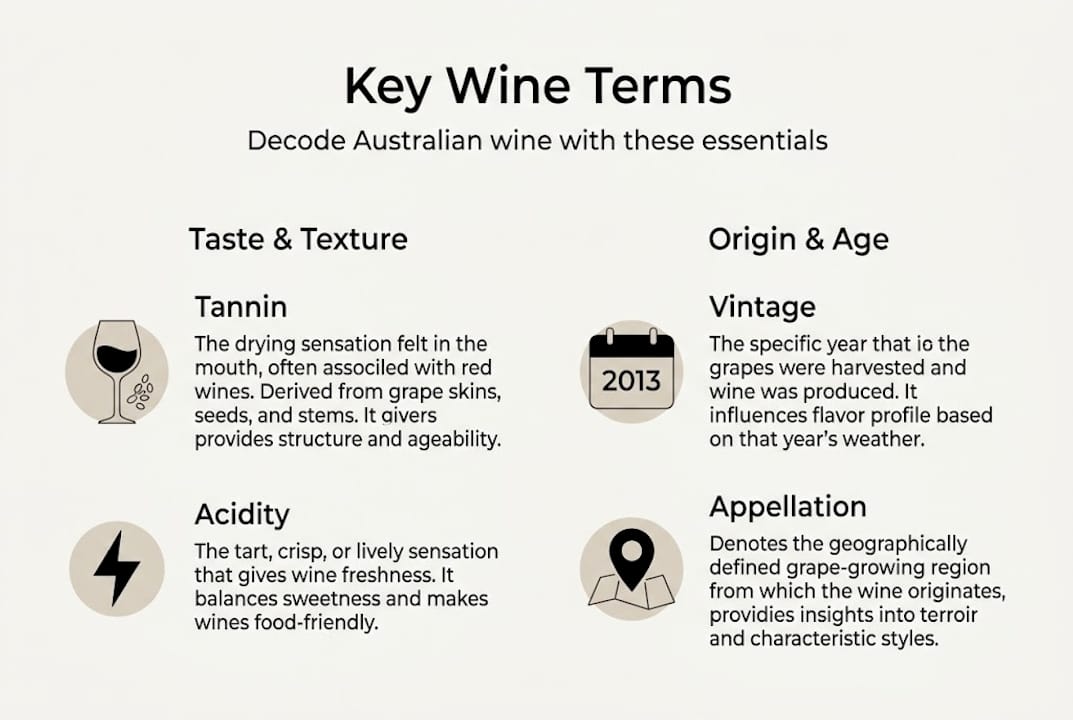
Three terms in particular do the heavy lifting when it comes to identifying quality wine: terroir, body, and vintage.
Terroir refers to the unique environmental factors including soil, climate, and topography that impart a sense of place to wine. Think of it as a wine’s fingerprint. A Shiraz from the Barossa Valley tastes nothing like one from Margaret River, even if the winemaking is identical. That difference is terroir at work.
“Terroir is wine’s way of saying ‘I’m from somewhere specific, and that place matters.’ Every sip is geography in a glass.”
Body refers to how a wine feels in your mouth, think light and delicate like a Pinot Gris or full and rich like a Hunter Valley Semillon aged for a decade. Vintage simply means the year the grapes were harvested. It matters because weather varies, and weather shapes flavour.
Here are the terms you’ll most commonly see on Australian wine labels:
- Variety or varietal (the grape type, e.g. Shiraz, Chardonnay)
- Region or GI (Geographic Indication, the legally recognised growing area)
- Reserve (often indicates selected fruit or extended ageing, though it’s not legally defined in Australia)
- Unwooded or unoaked (no barrel maturation, meaning fresher, fruit-driven styles)
- Single vineyard (fruit from one specific site, often a quality signal)
Pro Tip: When a label says “Reserve” without specifying what that means, treat it with healthy scepticism. Labels like single vineyard or a named GI region carry more weight when it comes to wine scores explained and genuine quality signals.
The essential wine terms every Australian should know
With the value of terminology clear, let’s get into the must-knows for anyone interested in wine quality and value. These are the terms you’ll hear at tastings, see in reviews, and need when you’re buying smart.
| Term | What it means | Why it matters |
|---|---|---|
| Tannin | Textural compound from skins, seeds, and oak | Gives structure and helps wine age |
| Acidity | Tartness or freshness in the wine | Balances sweetness and extends life |
| Body | Weight and richness in the mouth | Guides food pairing and style preference |
| Vintage | Harvest year | Affects flavour profile and age-worthiness |
| Aroma | Primary scents from the grape | Tells you about variety and freshness |
| Bouquet | Scents from ageing and maturation | Signals development and complexity |
| Appellation | Legally defined growing region | Guarantees origin and often style |
| ABV | Alcohol by volume (percentage) | Influences body, heat, and sweetness perception |
| Dry | Low residual sugar | Not about flavour alone, it’s about sugar content |
| Sweet | Higher residual sugar | Balances acidity in dessert and off-dry styles |
Tannins are polyphenols from skins, seeds, stems, and oak. They create that drying, gripping sensation you feel after sipping a young Cabernet Sauvignon. They also preserve wine and stabilise colour, and they soften over time through a process called polymerisation, which is why big tannic reds improve with cellaring.
Acidity in wine is measured by pH between 3.0 and 4.0 or total acidity between 5.5 and 8.5 grams per litre. High acidity makes wine feel lively and mouth-watering. It also enhances the perception of tannin and balances sweetness beautifully.
When you understand the wine tasting process, these terms go from abstract to instinctive. You stop being a passive drinker and start being an active one.
Collectors particularly focus on these terms when evaluating age-worthiness:
- Tannin level (higher generally means longer ageing potential)
- Acidity (the backbone that keeps wine fresh over decades)
- Alcohol (very high alcohol can throw balance off in older wines)
- Residual sugar (can act as a preservative in certain styles)
How appellation and vintage influence quality and value
Understanding key terms is one thing. Knowing how they interact to affect real-world value is another. Appellation and vintage are the two biggest influences on what a wine is worth and how it will taste.
Appellation is a legally defined grape-growing region with rules governing varieties, yields, and methods. Not all appellation systems are equal. Here’s how the major ones compare:
| System | Country | What it controls | Strictness |
|---|---|---|---|
| AOC (Appellation d’Origine Contrôlée) | France | Varieties, yields, methods, geography | Very strict |
| AVA (American Viticultural Area) | USA | Geography only, 85% grapes from area | Moderate |
| DOC/DOCG | Italy | Detailed varietal and production controls | Strict |
| GI (Geographic Indication) | Australia | Geography only | Relatively flexible |
Australia’s GI system tells you where the grapes were grown, but not how the wine was made. That means a Barossa Valley label tells you origin, not production method. France’s AOC is far more prescriptive. This is useful to know when comparing international bottles.
For appellations explained in real buying terms, follow this label-reading sequence:
- Identify the region first. Known regions with reputations tend to deliver more consistent quality.
- Look for sub-regions or single vineyard notes. These narrow the origin and often signal higher quality.
- Check the vintage year and research whether it was a strong season.
- Cross-reference with independent scores if available.
- Compare prices across retailers. If one is dramatically lower, ask why.
Pro Tip: Lesser-known sub-regions often offer outstanding quality at a fraction of the price of famous neighbours. Think Wrattonbully versus Coonawarra, or Mornington Peninsula versus Yarra Valley. Our vintage guide and wine vintages explained articles dig deeper into how to use this knowledge when hunting value. And if you want to see what cellar-aged wine examples look like in practice, there’s plenty to explore.
Advanced terms: Balance, structure, and what sets collectable wines apart
While most everyday wine buyers focus on basics, serious collectors are laser-focused on what sets great bottles apart. These are the terms that separate a good wine from one worth hunting down and holding onto.
Balance is the single most important marker of quality. Balance is the harmony of acidity, tannin, alcohol, and sweetness working together without any single element dominating. A wine with too little acid is called flabby. One with too much alcohol feels hot. Harsh, unripe tannin is the most common flaw in cheap reds trying to impersonate serious ones.
Structure is the framework that gives a wine its shape. Think of it like architecture. A well-structured wine has visible lines of acidity and tannin holding everything up. Without structure, even a great fruit expression collapses with time.
“Balance doesn’t mean everything is equal. It means everything is proportional. A powerful Barossa Shiraz can be perfectly balanced even at full throttle.”
What to look for in an age-worthy, collectable wine:
- Firm but ripe tannins (grippy but not aggressive)
- High natural acidity (lively, not sour)
- Alcohol that integrates rather than burns
- Flavour depth that evolves rather than fades quickly on the palate
High tannin and high acidity wines like Nebbiolo and Cabernet Sauvignon can age between 10 and 50-plus years through polymerisation, with benchmark Cabernet Sauvignon containing between 1,500 and 1,600 mg/L of tannins. Understanding this transforms the way you shop for bottles worth keeping.
Pro Tip: At tastings, power impresses in the short term but balance wins every time over years in the cellar. When you’re evaluating wine desirability and using wine scoring for collectors, weight balance far above raw intensity. It’s the real predictor of long-term satisfaction.
Our perspective: Most wine jargon is about confidence, not complexity
Here’s what the industry won’t tell you. Most wine terminology isn’t complicated. It’s just been kept deliberately obscure because confusion is profitable. Confused buyers defer to wine merchants, premium pricing, and fancy labels. Confident buyers ask better questions, find better value, and enjoy wine more.
The truth is, once you understand balance, origin, and vintage, you’ve mastered about 80 percent of what actually matters. True collectors don’t memorise a dictionary. They understand what drives identifying quality wine and apply that lens consistently.
The Australian approach to wine has always been refreshingly direct. We care about what’s in the glass, not what’s on the label. That instinct is exactly right. Let the French agonise over AOC rules. You just need to know which terms point to genuine quality and which ones are marketing noise. Now you do.
Start your premium wine journey
You’ve got the vocabulary. Now put it to work. Shopping for wine with these terms in your toolkit completely changes the experience. You stop being overwhelmed and start feeling like an insider.
At FU Wine, we’ve done the hard yards sourcing premium and rare bottles at prices that actually make sense. No inflated markups, no pretentious gatekeeping. Just seriously good wine at aggressively fair prices. Browse our premium wine range and apply your new knowledge to every bottle you consider. Or explore the collection and see what’s currently available before someone else snaps it up. Every bottle is a small rebellion against overpaying. You’re going to love it.
Frequently asked questions
What does terroir mean and why is it important?
Terroir refers to a grape’s environment including soil, climate, and topography, which gives wine its unique sense of place and character. It’s essentially the reason two wines made from the same grape can taste completely different depending on where they were grown.
How do I know if a wine will age well?
Wines with high acidity and firm tannins tend to age best, gaining complexity over time through polymerisation. High tannin varieties like Cabernet Sauvignon and Nebbiolo are classic examples worth cellaring.
What’s the difference between aroma and bouquet?
Aroma refers to the primary grape-derived scents while bouquet describes the more complex smells that develop during ageing and maturation. Together they form what’s called the wine’s “nose.”
Do terms like ‘dry’ and ‘sweet’ refer only to taste?
In wine, dry means low residual sugar content (under 12 grams per litre) and sweet means higher sugar levels. It’s a technical measure of sugar, not just a subjective flavour impression.
What is appellation and why should I care?
Appellation is a legally defined wine region with specific rules that help guarantee origin, style, and sometimes production methods. Understanding it helps you cut through label complexity and buy with real confidence.