

Unpacking expensive wines: What really drives prices
TL;DR:
- Fine wine prices are heavily influenced by supply chains, markups, and market speculation rather than quality alone. Total ownership costs, including storage, insurance, and taxes, can surpass the initial sticker price over time. Market scarcity, reputation, and economic factors cause significant fluctuations, making transparency in pricing essential for smart collecting.
You pick up a bottle, flip it over, and feel your jaw drop. It happens to the best of us. Fine wine pricing can feel like a riddle wrapped in a barrel, with the sticker price telling only a fraction of the real story. Beneath that number sits a tangle of supply chains, carrying costs, market dynamics, and speculative hype that most collectors never fully see. This guide pulls back the curtain on all of it, so you can make smarter decisions, spend with confidence, and know exactly what you’re paying for every single time.
Table of Contents
- Distribution chains and markups: Where your money goes
- Total ownership costs: Storage, insurance, and hidden fees
- Scarcity, reputation, and secondary markets: The price of rarity
- Market volatility and inventory swings: Economic influences on wine value
- Why sticker price is often misleading: Our serious take on transparency
- Discover transparent, fair wine pricing at FU Wine
- Frequently asked questions
Key Takeaways
| Point | Details |
|---|---|
| Supply chain markups | Every step from producer to retailer adds cost, making wines much pricier than production alone. |
| Hidden holding costs | Storage, insurance, and fees substantially increase the total cost of owning collectible wines. |
| Scarcity drives price | Rarity, age, and reputation propel certain bottles into astronomical price ranges far beyond retail. |
| Economic volatility matters | Macroeconomic trends and inventory cycles can swing wine prices even when quality stays the same. |
| Transparent pricing wins | Smart collectors compare all costs and market exposure, not just the sticker price, to get true value. |
Distribution chains and markups: Where your money goes
Let’s break down the first major factor boosting wine prices: supply chains and markups. Most people assume they’re paying for the wine. In reality, they’re often paying for the journey the wine took to reach the shelf.
The three-tier distribution system works like this: the producer sells to a distributor, the distributor sells to a retailer, and the retailer sells to you. Each of those handoffs comes with a margin added on top. By the time a bottle lands in your hands, the original production cost might represent only a fraction of what you paid.
Restaurants take it even further. A bottle a retailer sells for $60 might sit on a restaurant wine list for $180 or more. That’s not unusual. It’s standard practice. The markup exists to cover storage, service, and overheads, but it can make enjoying fine wine at a restaurant feel like a penalty for eating out.
Understanding wine distribution structures is genuinely useful here. The more tiers a bottle passes through, the more the price compounds. And for imported wines, add customs duties, import levies, and currency conversion costs on top. A French Burgundy or an Italian Barolo carries all those layers before it even hits a local distributor’s warehouse.
Here’s a rough comparison of how markups typically compound across channels:
| Channel | Typical markup on cost |
|---|---|
| Producer to distributor | 25–40% |
| Distributor to retailer | 30–50% |
| Retailer to consumer | 30–50% |
| Restaurant to consumer | 150–300% |
The real kicker? Those markups don’t reflect quality. They reflect logistics, relationships, and overheads. A wine might score 97 points and still be priced modestly because it moves through a lean, direct channel. Another bottle with the same score might cost three times as much because it travelled through four layers of middlemen.
“Every tier in the chain has mouths to feed. The wine is the same. The journey is what costs you.”
Good wine preservation insights remind us that what matters in the glass rarely changes based on how many warehouses the bottle visited. But the price tag absolutely does. Learning to unlock wine discounts starts with understanding exactly which parts of the price you’re actually paying for.
Total ownership costs: Storage, insurance, and hidden fees
After understanding markups, let’s look at another overlooked factor: the ongoing costs of storing and insuring prized bottles. Most collectors focus on purchase price. Smart collectors focus on total cost of ownership. There’s a meaningful difference.
Carrying costs accumulate over long holding periods, and for cellared or investment-grade bottles, storage and insurance alone can materially increase what you actually paid by the time you uncork that wine.
Professional storage facilities typically charge between $1 and $10 per bottle per year, depending on the facility, the region, and the level of climate control. For a cellar of 500 premium bottles, that’s potentially $5,000 a year before you’ve touched a drop. Over a decade-long hold, that cost rivals the original purchase price of mid-range premium bottles.
Insurance adds another layer. Most home contents policies won’t cover a serious wine collection at replacement value. Specialist wine insurance is available but costs roughly 0.5–1% of the insured value annually. On a $50,000 collection, that’s $250–$500 per year, every year.
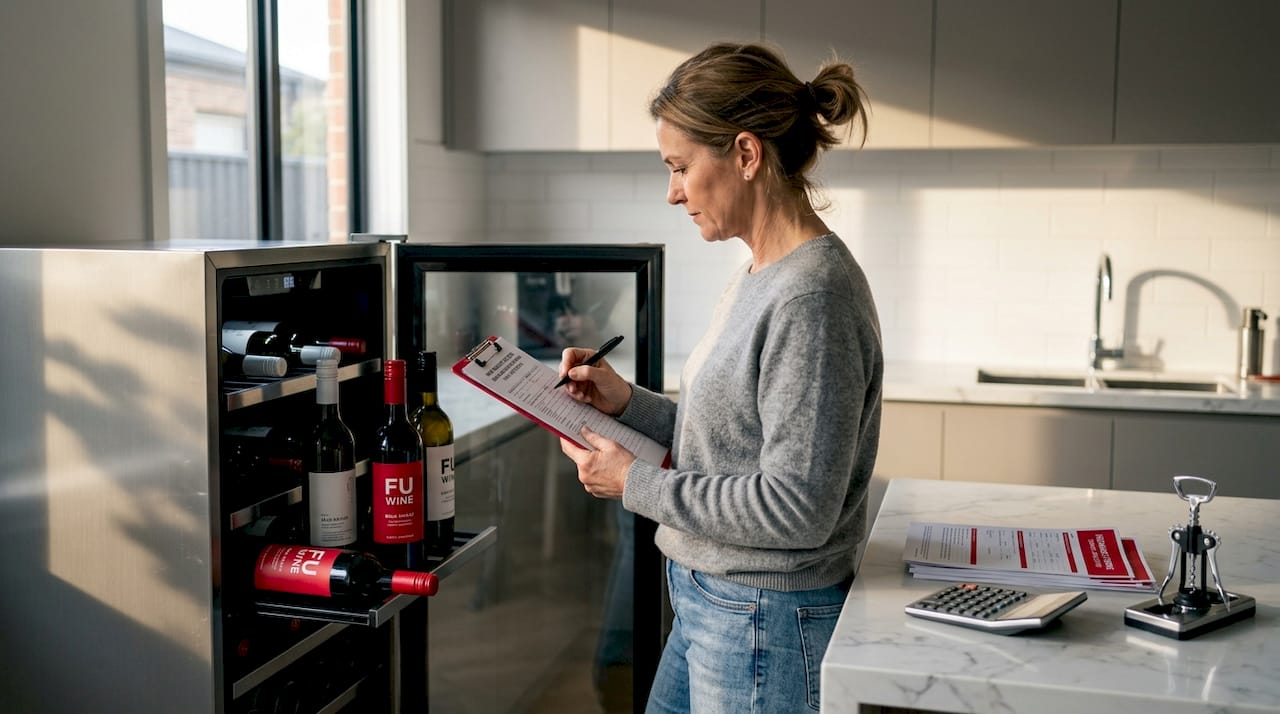
Pro Tip: When calculating whether a fine wine purchase is genuinely good value, add up the projected storage and insurance costs over your intended holding period and factor that total into your price-per-bottle assessment. You’ll often find that a “cheap” cellar purchase is considerably more expensive than it first appeared.
There are also the less obvious fees. Import duties and taxes vary by country and wine category. Some platforms charge consignment or handling fees. Auction houses take a buyer’s premium, often 15–25% on top of the hammer price. All of these eat into the value proposition.
Useful resources on wine cellaring tips and aging wine benefits can help you decide which bottles genuinely benefit from long-term holding, and which ones are simply accumulating storage costs without payoff. Understanding the wine investment benefits and reading a solid wine value guide will help you separate genuine long-term plays from expensive habits dressed up as strategy.
Here’s what total ownership cost might look like over ten years on a $500 bottle:
| Cost component | Estimated amount over 10 years |
|---|---|
| Purchase price | $500 |
| Storage (5 years at $5/bottle/yr) | $25 |
| Insurance (0.75% on $500, 5 years) | $18.75 |
| Auction buyer’s premium (if sold) | $75–$125 |
| Total estimated cost | $618–$668 |
The sticker price stopped telling the full story the moment you carried that bottle home.
Scarcity, reputation, and secondary markets: The price of rarity
Once hidden costs are factored in, the biggest price surges often come from rarity and the social cachet of collectible bottles. This is where wine pricing starts to feel genuinely surreal.
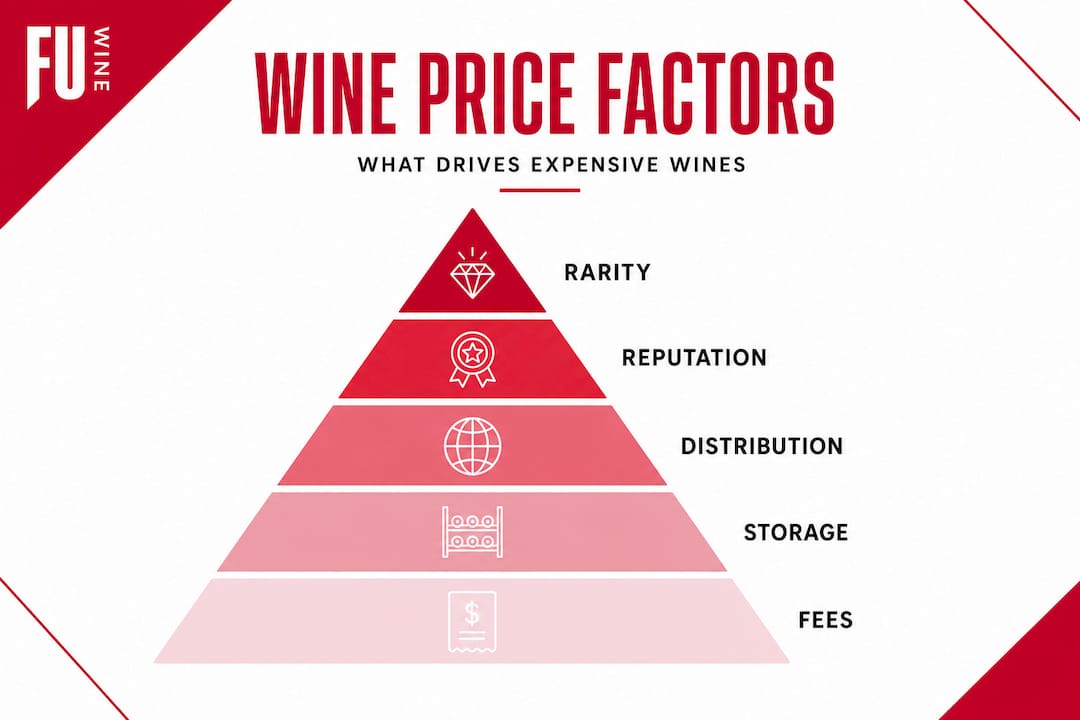
Take Domaine de la Romanée-Conti as the extreme example. The release price versus auction value on a single bottle can be separated by hundreds of thousands of dollars, not because the wine changed, but because scarcity and reputation made it a trophy asset. Only around 600 bottles of the 1945 vintage were produced. The producer didn’t set that price. The market did.
This is the fundamental truth most wine pricing articles dance around: the expensive price is often driven by market expectations and secondary-market trading, not what the winemaker chose to charge. Release price and resale price are two entirely different conversations.
Fine wine demand holds strong even in uncertain economic conditions, particularly in the $250 and above segment. Buyers at this level aren’t just drinking. They’re speculating. And when speculators hold, rotate, and trade, they create artificial scarcity that pushes prices upward even when supply hasn’t actually changed.
Here’s what drives secondary-market pricing in practical terms:
- Winemaker reputation: A single winemaker changing roles can shift a producer’s scores and prices within a single vintage.
- Critic scores: A 100-point score from a recognised publication can triple a bottle’s value overnight.
- Vintage quality: A drought, frost, or exceptional growing season affects production volume and perceived quality simultaneously.
- Provenance: Where and how a bottle was stored impacts its auction value significantly.
- Allocation access: If you couldn’t buy it at release, you’ll pay more on the secondary market. Always.
Learning wine auction secrets is genuinely valuable for navigating this terrain. And if you’re interested in sourcing rare bottles without the secondary-market premium, the wine scarcity guide is worth your time. Understanding fair access insights is the other side of the same coin: who gets the good bottles first, and why.
The uncomfortable reality is that the reputation economy in fine wine is largely self-reinforcing. Expensive bottles become more expensive because they’re expected to be expensive. That’s not cynicism. It’s market mechanics.
Market volatility and inventory swings: Economic influences on wine value
Beyond auctions and scarcity, let’s look at the ways larger economic forces and inventory swings drive unpredictable price movements. Wine is not immune to the real world. Far from it.
Macroeconomic conditions influence fine wine pricing in ways that would surprise casual buyers. Rising interest rates reduce liquidity. When money is tight, collectors sell. When a lot of collectors sell simultaneously, prices drop even if the wine itself is outstanding. Currency movements matter too. A strong Australian dollar makes imported bottles cheaper. A weak dollar makes them punishing.
At the other end of the spectrum, oversupply can crater prices at the bulk and commercial levels. Bordeaux has faced genuine oversupply challenges, with surplus volumes putting downward pressure on prices across certain categories. The wine is the same quality it was two years ago. The price is just lower because there’s too much of it.
Here’s how to monitor economic signals as a collector:
- Watch interest rate movements. Rising rates often soften fine wine prices as sellers liquidate assets.
- Track currency exchange rates. For imported wine, your real cost shifts even when the producer’s price doesn’t.
- Monitor auction clearance rates. If major auction houses are struggling to clear lots, prices are likely to soften.
- Read trade publications. Wine aging effects and market commentary together tell a fuller story than price lists alone.
- Check vintage reports early. Harvest news sets market expectations before bottles are even released.
Pro Tip: Set a Google alert for major wine regions combined with terms like “oversupply” or “surplus.” You’ll catch pricing softness before it hits most buyers’ radars, giving you a genuine edge when sourcing.
Understanding wine allocation insights alongside vintage basics gives you a framework for reading the market, not just the bottle. And knowing how to access premium wines without overpaying is where all this knowledge becomes actionable.
The truth is, a savvy buyer with a good grasp of economic cycles can find extraordinary bottles at reasonable prices. But only if they understand why prices move, not just when they move.
Why sticker price is often misleading: Our serious take on transparency
Here’s the honest view from where we sit. Sticker price is perhaps the least useful number in wine.
That’s not an exaggeration. When you factor in distribution tier markups, import duties, storage costs, insurance, auction premiums, and the time value of money locked up in a cellar, the sticker price stops being a reliable signal of anything except what a retailer decided to write on a tag.
True transparent pricing means comparing wines on total cost of ownership and channel exposure. That includes taxes and duties, the number of distribution tiers the wine passed through, and for bottles you intend to cellar, all the carrying costs along the way. Without that full picture, sticker price is basically marketing.
We’ve seen bottles priced at $120 that represent genuine value once you understand they came direct from a cellar clearance, through a single channel, with no auction house involved. We’ve also seen $80 bottles that are borderline fraudulent once you account for the chain of hands they passed through. The number on the label doesn’t discriminate.
What separates informed collectors from everyone else is the habit of asking “total cost of what?” rather than just “how much?” It’s the kind of elements of wine thinking that shifts you from passive buyer to genuinely sharp operator.
Market hype is the other thing worth naming directly. When a wine gets talked about enough, the price follows the noise, not the quality. Reputation inflates faster than it deflates. Which means overpaying for a hyped bottle is very easy, and catching the value that hype has temporarily bypassed is very profitable. Knowing how wine deals work and how to identify genuine value in that noise is the whole game.
Discover transparent, fair wine pricing at FU Wine
If reading all of that made you feel like the wine industry has been playing games with your wallet, you’re not wrong. And you don’t have to keep accepting it.
FU Wine exists precisely because premium wine shouldn’t come wrapped in mystery pricing and inflated margins. We source rare, high-scoring, and collectible bottles through direct relationships, cellar clearances, and opportunistic buying, then pass genuine savings on to you. No layers. No games. No pretension. Just outstanding wine at prices that make sense. Explore our rotating selection of premium bottles, flash deals, and insider-access offers at FU Wine, where transparency isn’t a marketing line. It’s the whole point.
Frequently asked questions
Do expensive wines always taste better?
Not always. As market expectations drive pricing far beyond production cost, price reflects rarity, reputation, and distribution more than flavour quality alone.
How can I find more affordable premium wines?
Compare total ownership costs, target direct distribution channels, and monitor auction and surplus market trends. Transparent pricing requires factoring in taxes, distribution tiers, and storage costs, not just the sticker.
Why do wine prices fluctuate so much year-to-year?
Macroeconomic conditions including interest rates, liquidity, and currency shifts all influence fine wine pricing, alongside inventory swings and evolving collector demand.
Are markups higher for wine in restaurants compared to shops?
Yes, significantly higher. The three-tier distribution system already adds layered markups before a bottle reaches a restaurant, where margins on premium bottles can reach 150–300%.
What’s the best way to ensure wine value doesn’t erode?
Store bottles correctly, insure valuable collections at replacement value, and monitor market and economic trends. Carrying costs accumulate silently, so building them into your valuation from day one protects your position.