

Explaining rare wine bottlings: a collector's guide
TL;DR:
- Rare wines are valued for their limited production, biological uniqueness, vintage importance, and provenance.
- Understanding these sources helps collectors avoid misjudging authenticity and value, especially via secondary markets.
Some bottles of wine have sold for more than a family home. That fact alone tells you that explaining rare wine bottlings is about far more than grapes and oak barrels. It is about history, scarcity, human obsession, and a secondary market that operates by its own rules. Whether you are building your first serious collection or trying to decode why a single bottle of 1945 Romanée-Conti fetched over half a million dollars, this guide cuts through the mystique. You will walk away knowing exactly what makes a wine rare, how to read the market, and how to source bottles without getting played.
Table of Contents
- Key takeaways
- What makes a wine bottling rare?
- Famous rare bottlings and their histories
- Bottle size, format, and ageing potential
- Market value and pricing of rare wines
- Sourcing, authenticating, and collecting rare bottles
- My honest take on collecting rare wines
- Find rare bottles without the nonsense
- FAQ
Key takeaways
| Point | Details |
|---|---|
| Rarity has many sources | Production volume, biological uniqueness, and historical events all create different types of rare wine. |
| Provenance drives value | Storage history and documentation often matter more than critic scores when pricing rare bottles. |
| Bottle format affects ageing | Large formats like Melchior and Melchizedek age more slowly, making them prized collector pieces. |
| Market mythology is real | Secondary prices for legendary wines are partly driven by speculation, not just winemaking quality. |
| Sourcing requires discipline | Mailing lists, reputable auction houses, and careful authentication protect collectors from fakes and overpaying. |
What makes a wine bottling rare?
Rarity in wine is not a single thing. It comes in several distinct forms, and confusing them is one of the most common mistakes collectors make.
The first form is production volume. California cult wines are defined by annual production below 1,000 cases, mailing list exclusivity, and secondary market prices running 3 to 10 times the original retail release. Screaming Eagle, Harlan Estate, and Colgin are textbook examples. Their rarity is engineered partly by design, but the demand behind it is absolutely real.
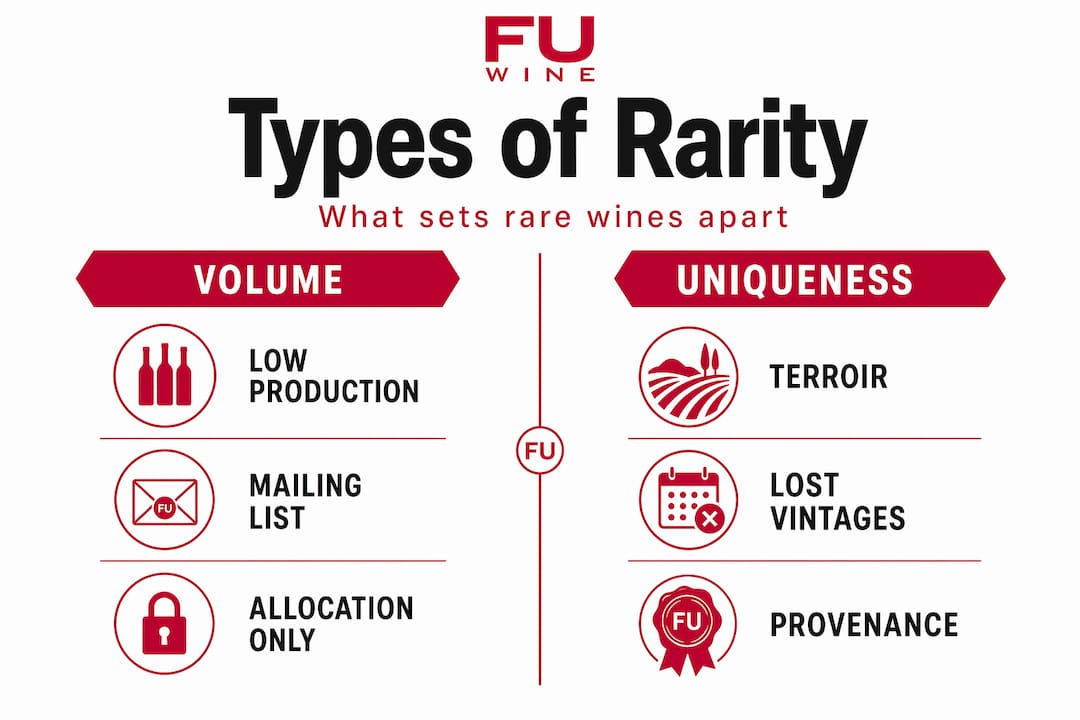
The second form is biological uniqueness. Some wines cannot be replicated because the conditions that created them no longer exist. Rare bottlings tied to ungrafted vines create a scarcity that no winemaker can manufacture artificially. Once those vines are gone, the wine they produced becomes a historical artefact.
The third form is vintage significance. A growing season scarred by war, frost, or extraordinary weather can produce wine that historians and collectors treat as irreplaceable.
A few other markers worth knowing:
- Classification-based rarity: German and Austrian Trockenbeerenauslese wines involve ultra-rare sugar levels exceeding 300g/L, produced only in exceptional years from hand-selected botrytised grapes. A single producer may yield just a few hundred bottles.
- Side releases and multi-vintage blends: Collectors increasingly seek small parcel releases that better reflect a winemaker’s philosophy than the flagship label.
- Provenance-restricted bottles: Estate-bottled wines from properties with strict allocation controls.
Pro Tip: When you are evaluating a rare wine, ask yourself which type of rarity you are dealing with. Volume rarity and biological rarity are very different propositions. The first can be manufactured; the second cannot.
Famous rare bottlings and their histories
This is where understanding rare wine really gets interesting. The stories behind the most coveted bottles are genuinely extraordinary.
The 1811 Château d’Yquem is one of the most mythologised bottles in existence. That year’s growing season in Sauternes was freakishly perfect, producing a wine so concentrated it has been described as tasting like liquid history. Only about 10 bottles of the 1811 Yquem have been authenticated, and verified examples have sold at auction for astonishing sums. What makes it rare is the combination of a once-in-a-generation vintage, two centuries of bottle age, and an almost total disappearance from the market.
The 1945 Romanée-Conti is the most famous wine in the world for a reason. The Domaine de la Romanée-Conti vineyard produces just 5,000 to 6,000 bottles per year in modern times. But the 1945 vintage was produced from the estate’s original ungrafted vines, the last harvest before the vineyard was replanted. Total production was approximately 600 bottles. Individual bottles have sold between $558,000 and $812,500 at auction. That is not just a price. It is a monument to biological irreversibility.
California cult wines bring rare wine bottlings firmly into the modern era. These are not centuries old. They are recent vintages from producers like Screaming Eagle and Sine Qua Non, where mailing list waitlists stretch 5 to 20 years and secondary market prices bear almost no relationship to the winery release price.
Trockenbeerenauslese dessert wines from Germany and Austria represent a different kind of glory. Produced through hand-selection of botrytised grapes in exceptional years only, these wines combine extreme terroir and craftsmanship in a way that makes them genuinely impossible to mass-produce. When a German Riesling TBA appears on the market, collectors move fast.
The lesson across all of these examples is the same. The value of vintage wine is inseparable from the story locked inside the bottle.
Bottle size, format, and ageing potential
Most people think about what is inside the bottle. Smart collectors also think about the bottle itself.
Standard 750ml bottles are the workhorse of the wine world. They age well under the right conditions. But large-format bottles like the Melchior at 18 litres and the Melchizedek at 30 litres slow the rate of oxygen exchange relative to wine volume, meaning the wine ages more gracefully and over a longer period. That is not a minor difference. It changes the entire trajectory of a wine’s development.
Here is a quick comparison of common formats and their collector relevance:
| Format | Volume | Collector appeal |
|---|---|---|
| Standard | 750ml | Widely available; good ageing |
| Magnum | 1.5L | Popular for gifting; ages well |
| Jeroboam | 3L or 4.5L | Rarer; impressive cellar presence |
| Melchior | 18L | Trophy format; extremely limited |
| Melchizedek | 30L | Rarest format; ceremonial use |
Rare large-format bottlings are produced in tiny numbers. A Melchior from a prestigious estate might represent one of only a handful of bottles filled from that vintage. That combination of careful ageing in large bottles with the underlying quality of the wine creates the kind of unique wine collections that attract serious money at auction. For a deeper look at how format affects cellar potential, the cellar-aged wine examples at FU Wine are worth your time.
Pro Tip: If you are buying a large-format bottle at auction, confirm that it was filled at the estate, not decanted into the larger vessel later. Estate-filled large formats carry a significant premium and age differently.
Market value and pricing of rare wines
The pricing of rare wine is rational in some places and completely irrational in others. Knowing the difference keeps you from making expensive mistakes.
The rational side works like this:
- Limited production reduces supply. When demand is constant or growing, prices rise. That is economics.
- Critical acclaim amplifies demand rapidly. A 100-point score from a respected critic can multiply enquiries overnight.
- Provenance and storage are non-negotiable. Rare bottle values depend heavily on provenance and storage condition alongside vintage significance. A poorly stored bottle from a legendary vintage is worth a fraction of a pristine example.
- Auction dynamics add a layer of competitive psychology. Bidders who want to say they own something often push prices well beyond calculated value.
The irrational side is more uncomfortable. Secondary market pricing for legendary wines is often driven more by market mythology and speculation than by intrinsic winemaking quality. Some bottles are expensive because they have always been expensive, and because owning them is a social signal. That does not mean the wines are bad. It means the price has partially decoupled from the liquid.
For collectors, this creates both risk and opportunity. If you understand what is driving a price, you can decide whether you are paying for wine or paying for a story. Sometimes paying for the story is fine. Just do it with your eyes open. The wine pricing breakdown on FU Wine’s site goes deeper on this if you want to stress-test your thinking before a purchase.
Vintage reports are your best analytical tool. Precise fruit selection under challenging conditions distinguishes exceptional vintages from average ones. Read them before you buy, not after.
Sourcing, authenticating, and collecting rare bottles
Knowing how to identify rare wines on the market is only half the challenge. Getting hold of them safely is the other half.
Here is what actually works for serious collectors:
- Get on mailing lists early. Cult wine producers release directly to list subscribers. Waiting for a bottle to appear on the secondary market means paying a substantial premium. For California producers, accessing wines without markups requires patience and early positioning.
- Use reputable auction houses. Christie’s, Sotheby’s, and specialist wine auction platforms offer provenance documentation as standard. Do not buy from sellers who cannot provide storage history.
- Authenticate before you commit. Cork branding, capsule integrity, and provenance documents are the three pillars of authentication. Any seller who resists inspection has something to hide.
- Check fill levels and label condition. High fill levels and intact labels are signs of good storage. Low fills and damaged labels suggest heat or humidity damage.
- Read vintage-specific reports. Not all years from a celebrated estate are equal. A great producer in an average year produces an average wine.
- Avoid buying for purely speculative reasons. The secondary market for rare wine is illiquid. Turning a bottle into cash quickly is harder than it looks.
The wine scarcity guide at FU Wine covers access strategies in detail for 2026, including which markets are currently seeing constrained supply.
My honest take on collecting rare wines
I have spent a lot of time around rare wine. What I have learned is that the people who get the most out of collecting are rarely the ones who obsess over prices. They are the ones who obsess over provenance and story.
In my experience, the biggest mistake collectors make is buying rarity as a proxy for quality. A wine can be genuinely rare and genuinely mediocre at the same time. The two are not the same thing. I have tasted bottles from celebrated vintages that were past their prime because someone stored them badly. And I have had bottles from supposedly modest years that were transcendent because the winemaker made all the right calls.
The other thing I have learned is that market mythology is real and it is expensive. Some prices exist because wealthy collectors have decided something should be worth a fortune, and that consensus becomes self-reinforcing. That does not mean you should never buy those bottles. It means you should understand what you are actually paying for.
My honest advice: build a collection around wines you would genuinely love to drink. Let rarity and investment potential be secondary considerations. The collectors I respect most are not the ones with the most expensive cellar. They are the ones with the most interesting one.
— Damien
Find rare bottles without the nonsense
FU Wine was built for exactly the kind of collector who has read this far. You know your stuff. You are tired of paying for labels and mythology when what you actually want is access to genuinely rare, genuinely great wine at prices that do not require a second mortgage.
FU Wine sources premium bottles directly, including limited releases, cellar clearances, and high-scoring vintages, and passes the savings straight to you. We are talking 30 to 70 percent below traditional retail on the kind of bottles that usually require a contact or a waiting list. No gatekeeping. No inflated story tax.
Browse the rare wine selection at FU Wine and see what is available right now. Stock rotates fast and the deals do not wait around. Neither should you.
FAQ
What does “rare” actually mean for a wine bottling?
Rarity in wine comes from low production volume, biological uniqueness, vintage significance, or provenance scarcity. A wine can be rare for one or several of these reasons simultaneously.
How do I identify rare wines before buying?
Look for documented provenance, authentic cork and capsule condition, verifiable storage history, and vintage reports confirming the year’s quality. Authentication is non-negotiable for serious acquisitions.
Why are some rare wines priced so far above their quality?
Secondary market speculation and constructed mythology drive prices beyond winemaking merit alone. Status and scarcity perception play a significant role in what collectors are willing to pay.
Are large-format bottles worth pursuing for a collection?
Yes. Large formats like the Melchior and Melchizedek age more slowly and gracefully than standard 750ml bottles, making them prized for long-term cellaring and trophy appeal at auction.
How do collectors get access to cult wine mailing lists?
You apply directly through the winery, but waitlists for top California cult producers can run between 5 and 20 years. Secondary market access is faster but significantly more expensive.