

Cult wines explained: Unlock rare quality without overpaying
TL;DR:
- Genuine cult wines are defined by small production, exclusive allocation, high critic scores, and strong secondary market premiums. Many wines marketed as “limited” lack the structural scarcity or validation needed for true cult status, often confusing volume with rarity. Australian wines can achieve cult recognition by meeting these core criteria, with proven market demand and consistent quality.
Some bottles sell on the secondary market for three to ten times their original release price. Screaming Eagle, for example, releases at under $1,000 USD yet trades at $3,000 to $6,000 on the open market. That’s not branding magic. That’s what happens when genuine scarcity meets proven quality and obsessive demand. Cult wines are a specific category: small production, exclusive allocation, consistent 95-plus critic scores, and secondary market prices that confirm their desirability vintage after vintage. If you’ve ever felt confused about what actually earns a wine cult status, this guide breaks it all down clearly and honestly.
Table of Contents
- What makes a wine a cult wine?
- Origin and evolution: From Napa icons to global cults
- How collectors access cult wines: Mailing lists and secondary markets
- Proving quality: Role of critical scores and market demand
- The real value of cult wines for Australian collectors
- Discover rare wines with FU Wine
- Frequently asked questions
Key Takeaways
| Point | Details |
|---|---|
| Scarcity drives value | Wines produced in under 1,000 cases per year and allocated exclusively are much more sought-after. |
| Critical scores matter | Consistent ratings of 95+ from leading critics are essential to cult wine status. |
| Market demand is key | Multi-vintage secondary market premiums confirm collectability and proved value. |
| Luxury doesn’t equal cult | High production luxury wines or limited editions are not cult unless they have proven demand and scarcity. |
| Access via mailing lists | Joining exclusive mailing lists is the best route to secure cult wines at their original release price. |
What makes a wine a cult wine?
Let’s kill a common myth first. Expensive does not equal cult. Plenty of high-priced wines move tens of thousands of cases every year. They’re prestigious. They’re enjoyable. But they are not cult wines.
True cult status requires four things working together at the same time. Production under 1,000 cases creates genuine scarcity. Allocation through exclusive mailing lists ensures that only a small group of loyal buyers can access each vintage directly. Consistent 95-plus point scores from publications like Wine Advocate or Wine Spectator confirm objective quality across multiple years. And secondary market prices sitting well above release price prove that the broader market agrees with all of the above.
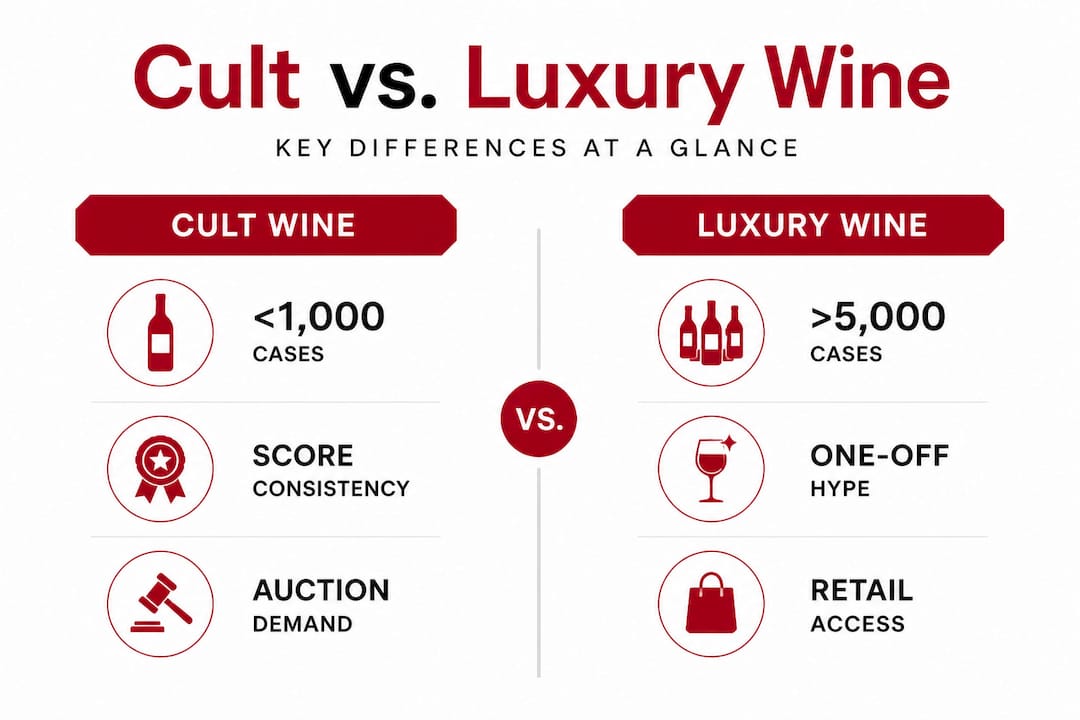
These four criteria are not negotiable. Strip one away and you’re looking at a very good wine, maybe even a great one, but not a cult wine in the structural sense.
Where does the confusion come from? Largely from producers who market limited releases as “exclusive” without the underlying scarcity or critical validation. Edge cases like luxury labels producing 5,000 to 10,000 cases, or limited releases from large producers with marketing budgets bigger than some small countries, often get mistaken for cult wines. They don’t qualify. Volume undermines exclusivity. Full stop.
Here’s a quick comparison to make this concrete:
| Feature | Cult wine | Luxury wine |
|---|---|---|
| Production volume | Under 1,000 cases | Often 5,000 to 50,000+ cases |
| Allocation method | Exclusive mailing list | Retail and wholesale |
| Critic scores | Consistently 95+ | Variable |
| Secondary market premium | 3 to 10 times release price | Marginal or none |
| Waitlist for access | Years in some cases | Usually available on shelf |
Understanding this table changes how you shop. If you want to build a genuinely collectible cellar, you need to think structurally, not just stylistically. A beautiful wine with wide distribution is a pleasure. A cult wine with proven secondary value is an asset.
Pro Tip: Before you call any bottle a “cult” wine, check its production size and secondary auction results. If it’s easy to find in bottle shops or online retailers, it almost certainly isn’t a cult wine regardless of the price tag.
“Not all rare wines are cult wines, but all cult wines are rare. The difference is in the proof, not the promise.”
When you’re exploring your next premium wine selection, keep these criteria front of mind. And if you want a deeper dive into finding rare bottles without the usual gatekeeping, the unlock rare wine guide is worth your time.
Origin and evolution: From Napa icons to global cults
The cult wine phenomenon didn’t emerge from thin air. It was born in Napa Valley during the 1990s, driven almost entirely by one man’s palate and one publication’s power.
Robert Parker’s 100-point scoring system transformed the wine world. When Parker awarded perfect or near-perfect scores to concentrated, ripe, bold Cabernet Sauvignons from small Napa producers, collectors went wild. Wineries like Screaming Eagle, Harlan Estate, and Bryant Family didn’t become famous through advertising. They became famous through scores, scarcity, and word of mouth among obsessive collectors.

This scoring-driven phenomenon, sometimes called “Parkerisation,” essentially created a template. A winemaker with access to exceptional fruit from low-yielding old vines, a production run under 1,000 cases, a mailing list instead of retail distribution, and a handful of perfect scores was suddenly sitting on something extraordinarily valuable. The formula replicated quickly across Napa.
Here’s how the geography and production of some iconic cult and near-cult wines compare:
| Wine | Region | Approximate production | Allocation method |
|---|---|---|---|
| Screaming Eagle | Napa Valley, California | Around 500 cases | Mailing list only |
| Harlan Estate | Napa Valley, California | Around 1,500 cases | Mailing list only |
| Le Pin | Pomerol, Bordeaux | 600 to 700 cases | Négociant allocation |
| Petrus | Pomerol, Bordeaux | Around 6,000 cases | Négociant allocation |
| Lafite Rothschild | Pauillac, Bordeaux | Around 30,000 cases | Retail and wholesale |
Notice something interesting here. Bordeaux legends like Lafite Rothschild produce far more than most California cults, making them prestigious but not structurally scarce in the same way. Le Pin, on the other hand, with its tiny production in Pomerol, sits much closer to true cult territory. Petrus occupies a fascinating middle ground: globally iconic, highly sought after, but with production numbers that push the edges of what most cult definitions allow.
The global expansion of cult wine culture has followed a predictable pattern:
- A small producer achieves a breakthrough score from a major critic.
- Demand exceeds supply almost immediately.
- Allocation shifts from retail to direct mailing list.
- Secondary prices confirm collector demand across multiple vintages.
- The wine achieves genuine cult status through market validation, not just marketing.
Understanding this evolution helps you spot the next wave of cult wines before the rest of the market catches on. Following aspirational wine discovery intelligently means watching small producers with exceptional vineyards, tracking emerging critic scores, and recognising when a wine’s allocation structure starts shifting toward exclusivity.
How collectors access cult wines: Mailing lists and secondary markets
Here’s where things get genuinely practical. You know what cult wines are. You know where they come from. Now let’s talk about how you actually get your hands on them.
The primary route is the mailing list. Most cult wine producers don’t sell through retail at all. You register on their website, you join the waitlist, and then you wait. For the most sought-after names, that wait can stretch to years. Some Napa cult producers have waiting lists so long they’ve stopped accepting new registrations altogether.
When you do get allocated, you typically receive an annual offer by email. You have a narrow window to accept and pay. Miss it, or decline, and you risk losing your place. The system rewards loyalty and patience over everything else.
A few practical strategies that actually help:
- Register early and everywhere. Don’t wait until a wine is famous to join its list. Follow emerging producers and get on their lists while they’re still accepting registrations.
- Buy at release, not at auction. Secondary market dynamics mean that cult wines trade at several times their release price once they hit auction houses. Buying at release is how you access real value.
- Stay engaged. Some producers move waitlisted buyers up the list based on engagement with their newsletters and events. Showing genuine interest pays off.
- Work with specialist brokers. Wine brokers with existing relationships to producers can sometimes access allocations that aren’t available to the general public.
Pro Tip: Don’t obsess only over the big names. Producers who are building toward cult status, with the right vineyards and rising scores, can offer similar quality and far easier mailing list access right now.
The secondary market is the other access point, but it costs you. Auction houses and specialist wine merchants regularly trade cult bottles, and prices reflect their scarcity. If you missed the release window, buying on the secondary market is legitimate, but go in with your eyes open about what you’re paying above release price.
For more detail on navigating this world, the guide on how to access limited wines covers the practical steps well. And if you want to understand the role that specialist wine curators play in cutting through typical markups, that’s worth a read too.
Proving quality: Role of critical scores and market demand
Critical scores matter enormously in the cult wine world, but they matter in a specific way. One 95-point score for a single vintage does not create a cult wine. What creates cult status is consistent 95-plus scores across multiple vintages. That consistency signals something structural about the vineyard, the winemaking approach, and the producer’s commitment to quality. It tells the market that this is not a one-off.
Wine Advocate and Wine Spectator scores of 95 or above are the benchmarks most collectors use. A score in this range signals exceptional quality by any standard measure. But the secondary market only truly rewards wines that maintain this level year after year, because a single great vintage can be a fluke. Multi-vintage confirmation is what separates the genuine article from the fortunate accident.
Here’s how scores connect to collectability in practice:
- 95 to 97 points: Excellent quality, high desirability, strong secondary market interest. This is the minimum range for serious cult consideration.
- 98 to 99 points: Exceptional. Secondary prices surge. Collector demand becomes intense.
- 100 points: Rare, transformative. A single perfect score from Parker or a comparable critic can permanently redefine a wine’s market value.
The relationship between scores and resale prices is not perfectly linear, but it’s predictable. Wines that achieve 95-plus consistently across five or more vintages almost always command secondary premiums that reflect that track record. The market is efficient in this sense.
Pro Tip: When evaluating a wine for its collectability, don’t just check the latest score. Pull up every score it has received over the past decade. Consistency over time is your best indicator of real value.
Market demand is the other side of the equation. Auction results from Christie’s, Sotheby’s, Acker Merrall, and other specialist wine auction houses provide real-time evidence of what collectors are willing to pay. Track a wine across several auctions before drawing conclusions. One high sale can be noise. A sustained pattern of strong bids is signal.
For a clear breakdown of how scores translate to real value, high-scoring wines explained gives you the full picture. And if you’re still getting comfortable with how the scoring systems work, the wine scoring guide is a solid foundation.
The real value of cult wines for Australian collectors
Let’s be honest about something the wider wine conversation tends to get wrong. The pursuit of cult wines is not really about luxury. It’s not about status or showing off a cellar full of famous labels. The genuine value lies in something far more interesting: structural scarcity meeting market-validated quality.
Australian collectors are particularly well-placed to benefit from this distinction. The temptation here, as in any market, is to chase prestige rather than provenance. A famous name with a glossy label and wide retail distribution is easy to find and easy to show off. But a structurally scarce wine with a proven secondary market record and consistent critical acclaim? That’s where real value sits.
The uncomfortable truth is that a lot of what gets called “collectable” in Australian wine circles is just expensive. True cult status requires the four criteria we covered earlier working in concert. Australian wines can absolutely achieve this. Penfolds Grange occupies a near-cult position by global standards. Several smaller Barossa, McLaren Vale, and Clare Valley producers are building the kind of critical recognition and allocation structures that could push them into genuine cult territory over the next decade.
The savvy move is to stop chasing the hype and start following the structure. Look for producers with deliberately constrained output, mailing list models, rising international critic scores, and early signs of secondary market interest. Those are the bottles worth building a collection around.
Understanding how cult wines fit into a broader investment context is worth your time. The wine investment benefits guide covers the financial side honestly, and if you’re thinking about building something cohesive rather than just grabbing bottles, build wine portfolio gives you a smart framework.
Conventional wisdom says collect what you can afford from the most famous names. Our take is different. Collect what’s proven, structurally scarce, and priced before the broader market catches on. That’s where the real wins are.
Discover rare wines with FU Wine
You’ve just sharpened your understanding of cult wines considerably. Now here’s the exciting part. You don’t need a years-long waitlist or a six-figure budget to access genuinely rare and premium bottles.
FU Wine is built for exactly this moment in your collecting journey. We source rare, limited-release, and high-scoring wines through direct relationships, distressed inventory opportunities, and cellar clearances that most buyers never hear about. The result is access to premium bottles at prices that make traditional retail look embarrassing. Browse our current selection at FU Wine and see what’s available right now before it’s gone. Because with cult-quality stock, it always goes fast.
Frequently asked questions
Are cult wines always expensive?
Cult wines usually command high secondary market prices, often three to ten times their release price, but collectors who access them through mailing lists at release can pay far more reasonable prices.
How do I join a cult wine mailing list?
You register directly on the winery’s website, but be prepared for a long wait. Many exclusive mailing lists have multi-year waitlists, and some of the most sought-after producers have closed their lists entirely.
Is a small production wine always a cult wine?
Not at all. True cult wines require multi-vintage secondary confirmation and consistent critical acclaim alongside small production, not just limited case numbers.
Can Australian wines gain cult status?
Absolutely. Any wine meeting the core criteria including production under 1,000 cases, mailing list allocation, consistent 95-plus scores, and proven secondary premiums qualifies regardless of country of origin.
Recommended
- Unlock exclusive wine access: rare bottles and savings – FU Wine
- Top rare wine varieties that impress without the price tag – FU Wine
- Unlocking wine exclusivity: How limited releases really work – FU Wine
- How to access premium wines without paying too much – FU Wine
- Discover what makes French boutique wineries unique – Res Fortes