

Explaining wine markups: what you're really paying for
TL;DR:
- Wine markups are the layers of profit added at each stage of the supply chain, which significantly inflate the final price. Understanding the three-tier system and using tools like Wine-Searcher can help buyers spot genuine value and avoid inflated restaurant prices. Direct-to-consumer sales and strategic questioning can further reduce costs and improve wine purchasing decisions.
Wine markup is the price multiplier applied at each stage of the supply chain, from producer to your glass, and it is the single biggest reason a bottle worth $15 at the winery can cost $60 on a restaurant wine list. The industry term is trade margin, though “markup” is the phrase most consumers use and most wine merchants understand. Explaining wine markups matters because once you see the layers, you stop feeling ripped off and start buying smarter. Distributors, retailers, and restaurant sommeliers each take a cut, and those cuts compound fast. This article breaks down exactly how that works, what the numbers look like, and how to spot genuine value in 2026.
Explaining wine markups: how the three-tier system stacks the price
The three-tier distribution system is the legal framework that governs how wine moves from producer to consumer in most markets, including the United States and many Australian states. Tier one is the producer or importer. Tier two is the distributor. Tier three is the retailer or restaurant. Each tier applies its own margin before passing the bottle along, and those margins compound through the chain.
Here is what that looks like in practice. A wine sold by a producer to a distributor at $15 per bottle typically reaches a retailer at around $30 before any restaurant markup is applied. That doubling happens before a single glass is poured. The distributor’s margin covers warehousing, logistics, sales staff, and compliance costs. None of that is padding. It is the actual cost of moving wine legally through a regulated system.
The structure differs slightly depending on where you are. In the United States, control states like Pennsylvania operate government-run retail monopolies, which affects pricing differently from licence states like California where private retailers compete. In Australia, the Wine Equalisation Tax (WET) and state-level liquor licencing fees add further layers on top of distributor margins. The result is that taxes and regulatory fees vary significantly by region and directly affect the final shelf price.
Small producers face a particular disadvantage in this system. Without the volume to attract major distributors, boutique wineries often struggle to get their bottles onto retail shelves at all. Distribution barriers for small producers limit availability and reduce pricing transparency, which is why direct-to-consumer models have grown so quickly. When a small Barossa producer sells direct, they bypass tier two entirely, and that saving can flow to you.
| Tier | Player | Typical margin added |
|---|---|---|
| Tier 1 | Producer or importer | Base wholesale price set here |
| Tier 2 | Distributor | Adds 25–40% on wholesale cost |
| Tier 3 | Retailer | Adds ~50% on distributor price |
| Tier 3 (alt) | Restaurant | Adds 150–200% on wholesale cost |
What are typical wine markup rates in restaurants versus retail?
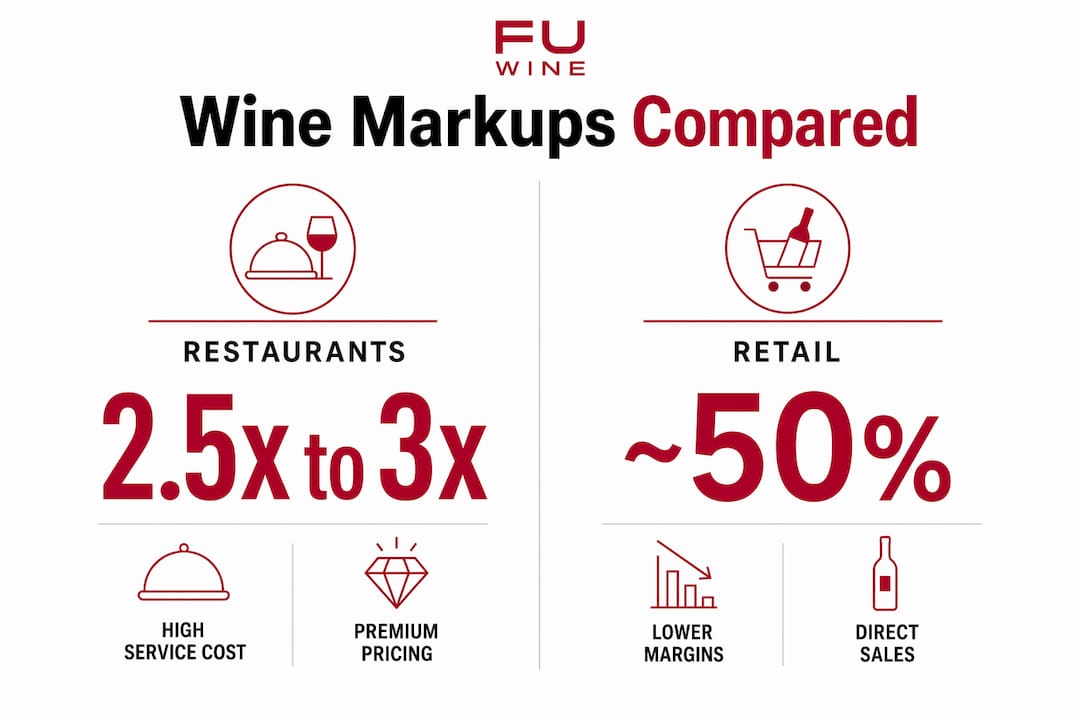
Restaurants mark up wine by 2.5 to 3 times the wholesale cost on average, which translates to a 200–300% premium over what the bottle cost the venue. A $20 retail bottle can appear on a wine list at $60 to $80. That is not greed. It is a pricing model built around the reality that wine sales carry disproportionate profit margins relative to food, and restaurants depend on that margin to stay viable.
The markup is not flat across all price points. Entry-level bottles carry higher percentage markups, often around 3x wholesale. Prestige bottles typically sit closer to 1.8x wholesale. This graduated model exists because restaurants know that customers are more price-sensitive at the $15 entry point than at the $150 prestige point. A collector ordering a $200 Penfolds Grange is less likely to baulk at a $360 list price than a casual diner is at paying $45 for a house Shiraz that retails for $12.
By-the-glass pricing follows a different formula entirely. The target pour cost sits at around 20 to 30% of the selling price, which means a restaurant aims to recoup the entire cost of the bottle from the first glass poured. Every subsequent glass is pure margin. A bottle that costs the venue $20 wholesale might be poured at $18 per glass, with four glasses per bottle. That is $72 revenue from a $20 cost.
Retail stores operate on far thinner margins. The average retail markup sits at around 50% on the distributor price. A bottle that costs a bottle shop $20 from the distributor sells for around $30 on the shelf. Lower overheads, no service component, and high volume justify the leaner margin.
| Channel | Typical markup | What drives it |
|---|---|---|
| Restaurant (bottle) | 2.5x to 3x wholesale | Service, overhead, spoilage, glassware |
| Restaurant (by the glass) | 5x wholesale cost | Pour cost target of 20% |
| Retail store | ~50% on distributor price | Lower overhead, volume-based model |
| Online direct-to-consumer | 10–30% on producer price | No distributor tier, lower logistics cost |
Pro Tip: When you see a wine on a restaurant list, divide the price by three to estimate what the venue paid wholesale. If that number is lower than the wine’s retail price, you are getting a relatively fair deal for the channel.
Why do wine markups happen? The economics behind the price
Markups are pricing decisions based on demand sensitivity, not arbitrary greed. Economic theory confirms that firms set markups based on how sensitive buyers are to price changes. Where switching costs are high or product differentiation is strong, markups stay elevated. A restaurant wine list is a closed market. You cannot pop out and grab a cheaper bottle from the shop next door. That captive environment justifies a higher margin.
Restaurants also carry real operational costs that casual diners rarely consider. Glassware replacement, climate-controlled storage, trained floor staff, spoilage from opened bottles, and the cost of maintaining a cellar all sit behind that list price. A sommelier’s salary alone can represent a significant overhead that the wine margin must help cover.
“The wine list is not just a menu. It is a financial instrument. Every bottle priced on it is calculated against landed cost, pour targets, and margin goals that most diners never see.” This is the reality behind understanding wine merchant pricing markup.
Landed bottle cost includes the per-bottle wholesale price, taxes such as WET and excise, freight, and any applicable discounts. Restaurants track all of these inputs in pricing spreadsheets and adjust list prices on a re-pricing cadence to protect margin targets when costs shift. That is why a wine you ordered last year at $55 might be $62 today, even though the vintage has not changed.
Taxes add another layer that consumers rarely see itemised. In Australia, the WET applies at 29% of the wholesale value of wine. Excise duties, GST, and state-level licencing fees stack on top. These are not markup in the traditional sense, but they inflate the final price in ways that look identical to margin from the outside.
How to spot wine value despite the markups
Spotting value on a wine list or retail shelf is a skill, and it is learnable. The starting point is understanding that not all markups are equal, and not all high prices signal poor value.
Start with the divide-by-three rule for restaurants. Take the list price, divide by three, and compare that estimated wholesale cost to what the wine retails for online. Tools like Wine-Searcher and Vivino show real-time retail prices across hundreds of merchants globally. If the estimated wholesale cost is lower than the retail price you find, the restaurant’s margin is within normal range. If it is significantly higher, you are looking at a premium above typical restaurant pricing.
Second, watch the graduated pricing trap. Entry-level bottles on a restaurant list often carry the highest percentage markups. The $14 house wine is frequently a $4 to $5 wholesale bottle. Moving one tier up to a $25 or $30 bottle often delivers dramatically better quality at a proportionally lower markup. This is the single most consistent value move you can make on a restaurant wine list.
Third, ask the sommelier directly. Sommeliers are trained to match wine to budget, and most will point you toward better value options if you ask. Phrases like “what is drinking well around the $50 mark?” open a conversation that a wine list alone cannot. Sommeliers know which bottles have the most favourable wine pricing strategy relative to quality on any given night.
Pro Tip: Cross-check any bottle you are considering on Wine-Searcher before ordering. A two-minute search on your phone can tell you whether a $90 restaurant pour is a reasonable margin or an outlier worth skipping.
For retail, compare prices across multiple channels. Direct-to-consumer purchases from producers, flash-deal platforms, and specialist retailers often undercut standard bottle shop pricing by 20 to 40% on the same wine. Knowing the factors affecting wine prices at each channel level is the difference between paying full retail and paying what insiders pay.
Key takeaways
Wine markups are a structured, multi-tier pricing system, and understanding each layer is the most direct way to find genuine value in any channel.
| Point | Details |
|---|---|
| Three-tier compounding | Each distribution tier adds its own margin, often doubling the producer price before retail. |
| Restaurant markup range | Restaurants typically apply 2.5x to 3x wholesale cost, with by-the-glass pricing targeting a 20% pour cost. |
| Graduated pricing reality | Entry-level bottles carry the highest percentage markups; moving one tier up delivers better value. |
| Retail is leaner | Retail store markups average around 50%, making bottle shops significantly cheaper than restaurants for the same wine. |
| Tools that help | Wine-Searcher and Vivino let you cross-check any price against real-time global retail data in seconds. |
The markup game is rigged, but you can play it smarter
I have spent years watching people overpay for wine, not because they lack taste, but because they lack information. The markup system is not designed to be transparent. It is designed to feel inevitable. And that invisibility is exactly what keeps it profitable.
The thing most casual buyers miss is that the markup on a $15 house wine at a restaurant is often a worse deal than the markup on a $100 bottle at the same venue. Prestige bottles carry lower percentage markups because venues know collectors will do their homework. Entry-level bottles carry higher markups because most diners will not. That asymmetry is worth knowing.
I also think the direct-to-consumer shift is the most underrated development in wine buying right now. When a boutique Margaret River producer sells direct, you are often paying close to wholesale. No distributor tier. No retail margin. Just the wine at something close to its actual cost. Platforms and merchants who understand wine distribution and buy opportunistically can pass those savings on. Most traditional retailers cannot.
My honest advice: use Wine-Searcher before you buy anything over $50. Ask sommeliers for value picks rather than defaulting to the second-cheapest bottle (that one is always the highest-margin item on the list). And find a merchant who is genuinely motivated to sell you quality at a fair price, not just to move stock at maximum margin.
— Damien
Stop paying the markup tax. FU Wine has a better idea.
FU Wine exists because the markup system is broken for buyers. Every bottle on the FU Wine platform is sourced through direct relationships, opportunistic buying, and cellar clearances that cut out the layers most consumers never see. Premium wines, rare vintages, and high-scoring bottles at prices that are typically 30 to 70% below traditional retail. Not clearance stock. Not bulk surplus. The real thing, priced the way it should be.
If you are tired of paying restaurant prices for bottles you are taking home, or watching great wines sit behind inflated retail tags, FU Wine is the antidote. Browse the current deals on premium wine and see what fair pricing actually looks like.
FAQ
What is a wine markup?
A wine markup is the percentage or multiplier added to the wholesale cost of a bottle at each stage of the supply chain, from distributor to retailer or restaurant, before it reaches the consumer. The industry term is trade margin.
Why are restaurant wine markups so high?
Restaurants apply 2.5 to 3 times the wholesale cost because wine sales carry the profit margin that subsidises food service, staff, glassware, storage, and spoilage costs that food alone cannot cover.
What are hidden wine markups I should know about?
Hidden markups include taxes like Australia’s Wine Equalisation Tax, freight costs, and state licencing fees that inflate the landed cost before any retail or restaurant margin is applied. These are built into the price but never itemised on a wine list.
How do I check if a wine price is fair?
Use Wine-Searcher or Vivino to find the current retail price of any bottle, then apply the divide-by-three rule for restaurant lists to estimate the venue’s wholesale cost. If the numbers align with industry norms, the price is reasonable for the channel.
Is retail always cheaper than buying wine at a restaurant?
Yes, consistently. Retail markups average around 50% on distributor cost, while restaurant markups run 200 to 300% over retail price. The same bottle is almost always cheaper at a bottle shop than on a wine list.