

Industry terminology for wine collectors: the real guide
TL;DR:
- Wine terminology is essential for evaluating, buying, and trading fine wine with confidence, especially terms like en primeur, provenance, and vintage. Provenance, storage, and label regulations significantly influence a wine’s value and authenticity, with rigorous standards like ex-Château provenance commanding premiums. Understanding market dynamics, auction procedures, and label rules provides collectors with a strategic edge to make informed, confident decisions.
Industry terminology for wine collectors is the specialised vocabulary that enables you to evaluate, buy, sell, and trade fine wine with genuine confidence. Terms like en primeur, provenance, and vintage are not decorative jargon. They are the operating language of a market where a single misunderstood phrase can cost you thousands or cause you to miss a genuinely great acquisition. Whether you are navigating a Bordeaux futures campaign, reading a label from a Napa Valley AVA, or consigning bottles through Sotheby’s, this vocabulary is your edge.
What are the most essential wine collecting terms?
Wine collector jargon starts with a handful of terms that appear constantly across auctions, merchant listings, and cellar records. Getting these right is not optional for serious collectors.
En primeur is the practice of buying wine before bottling, typically 18 to 24 months ahead of delivery. Bordeaux is the spiritual home of en primeur, running campaigns through a three-tier chain of châteaux, courtiers (brokers), and négociants, with brokers receiving a 2% commission. The appeal is early access to allocated bottles at pre-release pricing. The catch is that you are committing capital to wine you cannot touch, taste, or sell for nearly two years. That timing gap shifts the entire burden of storage and provenance management onto you from day one.
Provenance is the full documented chain of custody for a bottle, covering ownership, storage conditions, and transportation history from the producer to your cellar. It is the single most scrutinised concept in fine wine collecting, and we will unpack it in detail shortly.
Vintage refers to the year the grapes were harvested. A vintage year on a label is not just a date. It signals climate conditions, production decisions, and ageing potential specific to that harvest. Understanding vintage quality and rarity is foundational to making smart acquisition decisions.
Here are the other terms every collector needs in their toolkit:
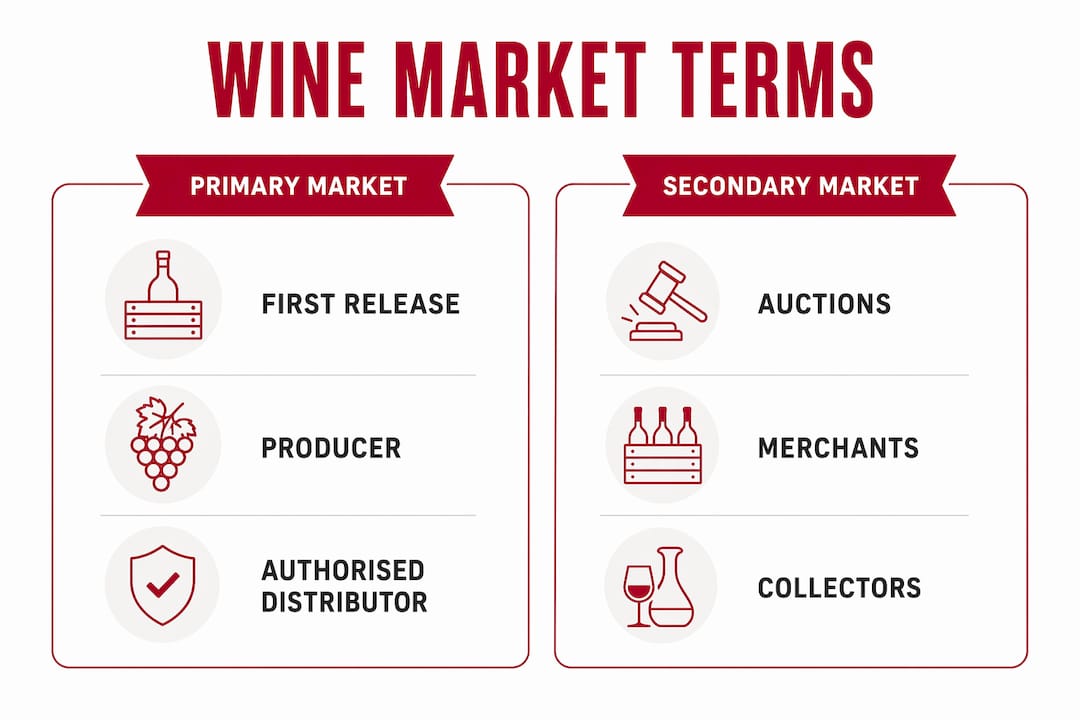
- Primary market: The first commercial release of a wine, directly from the producer or their authorised distributors. En primeur is a primary market transaction.
- Secondary market: All subsequent sales, including merchants, brokers, auction houses, and private transactions. Secondary market pricing is driven by supply, demand, provenance, and brand strength.
- Consignment: The process of submitting bottles to an auction house for sale. The auction house inspects condition, fill levels, and provenance before accepting a lot.
- Condition grading: A standardised assessment of a bottle’s physical state, including label quality, capsule integrity, and fill level. Grading directly affects the pre-sale estimate.
- Lot: A group of bottles offered as a single auction unit, which may be a single bottle, a case, or a mixed selection.
Pro Tip: When you see “OWC” on a listing, it means Original Wooden Case. This detail matters because sealed, original packaging is one of the strongest signals of unbroken provenance and supports both liquidity and price at resale.
How does provenance affect wine value and authenticity?
Provenance is not just where a wine came from. It is the complete lifecycle record of every bottle, and it is the highest standard in fine wine authentication.
The gold standard is ex-Château or ex-Domaine provenance. This means the wine was stored at the producing estate from bottling until the point of sale. No third-party cellars, no transit risk, no gaps in the record. When a bottle carries this designation, buyers pay a premium because the risk of mishandling is as close to zero as the market allows. Detailed provenance can command premiums of 20% or more at auction. That is not a small number on a case of first-growth Bordeaux.
When you are evaluating provenance on any bottle, here is what to verify:
- Storage history: Was the wine kept in temperature-controlled, humidity-stable conditions? Fluctuations accelerate ageing and can ruin a bottle that looks perfect from the outside.
- Fill level: The space between the wine and the cork is called ullage. Low fill levels suggest evaporation or seepage, both of which indicate compromised storage or a faulty seal.
- Label condition: Damp, stained, or torn labels often indicate poor storage. They also reduce resale value even when the wine itself is sound.
- Capsule integrity: A damaged or corroded capsule can signal cork issues or improper handling during transport.
- Documentation: Purchase receipts, cellar records, and shipping invoices form the paper trail that supports a provenance claim. No paper trail means no provenance.
“Market pricing values evidence-based factors like provenance and storage over the story behind the label.” — La Fleur Wines
Provenance also functions as fraud prevention. The fine wine market has seen high-profile counterfeiting cases, and rigorous provenance checks are the primary defence. Auction houses like Sotheby’s enforce strict provenance scrutiny before accepting consignments, and missing storage history can depress or outright disqualify a lot from sale.
What are the main wine markets and how do they work?
Understanding the structure of wine markets is where collecting vocabulary becomes genuinely strategic. The primary and secondary markets operate by different rules, and the terminology reflects those differences.
The primary market covers first releases. You are buying directly from the producer, a négociant, or an authorised importer. Prices are set by the producer and reflect their positioning. En primeur is the most prominent primary market mechanism, but direct allocation releases and cellar door sales also qualify.
The secondary market is everything after that first sale. Merchants, brokers, auction houses, and private collectors all participate. Prices here are set by supply and demand, not the producer. A wine that underperformed at release can trade at a premium on the secondary market a decade later if critical scores improve or the vintage gains recognition.
| Feature | Primary market | Secondary market |
|---|---|---|
| Price setter | Producer or authorised distributor | Supply and demand |
| Provenance risk | Low (direct from source) | Variable, requires verification |
| Access | Allocation-based, often restricted | Open, but condition-dependent |
| Typical buyer | Collectors seeking futures or new releases | Collectors, investors, and resellers |
| Liquidity | Fixed at release | Varies with brand strength and scarcity |
Auction house terminology deserves its own attention. When you consign a bottle, the house conducts a detailed inspection of provenance and condition before assigning a pre-sale estimate. That estimate is the range within which the house expects bidding to land. The reserve price is the confidential minimum below which the lot will not sell. The hammer price is the final bid accepted. The buyer’s premium is the additional percentage charged to the winning bidder on top of the hammer price, typically ranging from 15% to 25% depending on the house.
Pro Tip: Before consigning at auction, prepare a condition report and gather all storage documentation. Auction houses like Christie’s and Sotheby’s use this material to set estimates. A well-documented lot consistently achieves stronger results than an equivalent bottle with no paper trail.
Secondary market liquidity depends on brand strength, scarcity, provenance, and condition. A Penfolds Grange in original packaging with cellar records is a liquid asset. The same wine in a damaged box with no history is a much harder sell.
How do label and vintage terms affect collector confidence?
Reading a wine label correctly is a skill that separates informed collectors from everyone else. The regulatory framework behind label claims is more specific than most people realise, and misreading it leads to flawed quality assumptions.
In the United States, the Alcohol and Tobacco Tax and Trade Bureau (TTB) sets the rules. The vintage percentage threshold differs depending on the appellation level stated on the label. If a wine carries an American Viticultural Area (AVA) designation, 95% of the grapes must come from the stated vintage year. If the label states only a state or county appellation, the threshold drops to 85%. A vintage date cannot appear at all unless the label carries an appellation smaller than country level.
This matters for collectors because a wine labelled with a prestigious AVA like Napa Valley carries a stricter vintage guarantee than one labelled simply as “California.” The quality signal is stronger, and the regulatory backing is tighter.
The varietal rules are equally specific. The TTB requires a minimum of 75% of the named grape variety for varietal labelling, not the commonly cited 80%. The 80% figure is a misconception that circulates widely in wine education. Exceptions exist for Vitis labrusca varieties like Concord, where 51% suffices with a qualifying statement on the label.
Appellation rules add another layer. A wine labelled with a specific geographic designation must source the stated percentage of grapes from that region. For AVA wines in the US, that threshold is 85%. For Australian Geographical Indications, the rules differ again, requiring 85% sourcing from the stated region under the Label Integrity Programme administered by Wine Australia.
Common misconceptions collectors encounter include:
- Assuming “Reserve” carries a legal definition. In Australia and the US, it does not. Any producer can use it.
- Believing a high vintage score applies to the entire appellation. Scores are producer-specific, not region-wide.
- Treating “estate bottled” as a universal standard. The TTB definition is strict in the US, but the term has no legal weight in many other countries.
Understanding wine label terminology at this level of detail gives you a genuine advantage when assessing bottles for purchase or resale.
Key takeaways
Mastering wine collector jargon requires understanding provenance, market structure, and label regulations as interconnected systems, not isolated definitions.
| Point | Details |
|---|---|
| Provenance is the priority | Ex-Château provenance and full storage documentation can command premiums of 20% or more at auction. |
| En primeur shifts risk to you | Buying futures means managing storage and provenance for 18 to 24 months before delivery arrives. |
| Market structure shapes price | Primary market prices are producer-set; secondary market prices reflect supply, demand, and bottle condition. |
| Label rules are stricter than you think | AVA wines require 95% vintage sourcing; varietal labelling requires 75% of the named grape, not 80%. |
| Auction terminology is gatekeeping | Understanding consignment, reserve price, and buyer’s premium protects you from costly surprises at sale. |
Why terminology is the real collecting edge
Here is my honest view: most collectors over 35 already know what en primeur means. What they underestimate is how much the application of these terms differs from the textbook definition.
I have watched collectors lose money on secondary market purchases not because they did not know what provenance meant, but because they accepted a vague provenance claim without asking for the actual storage records. “Professionally stored” is not provenance. A temperature log from a bonded warehouse is provenance. That distinction is worth real money.
The label terminology section is where I see the most confident mistakes. Experienced collectors regularly cite the 80% varietal threshold as fact. The actual TTB rule is 75%. It sounds minor until you are making a buying decision based on blend assumptions that turn out to be wrong.
My practical advice: build your vocabulary around the terms that affect your specific collecting strategy. If you are buying for resale, prioritise secondary market liquidity terms and auction house procedures. If you are buying to drink and hold, focus on vintage assessment and storage terminology. The wine industry vocabulary is broad, but your collecting decisions are specific.
The collectors who consistently outperform are not the ones with the largest glossary. They are the ones who know which three or four terms matter most for the transaction in front of them, and who apply those terms with precision.
— Damien
Explore premium wines with FU Wine
FU Wine is built for collectors who are done paying for pretension. Every bottle in the catalogue comes with verified provenance and storage credentials, because that is what actually protects your investment. The collector’s value guide on the FU Wine blog breaks down exactly how storage, documentation, and market conditions affect what your bottles are worth. And if you want to put this terminology to work on real acquisitions, the FU Wine catalogue is where rare, high-scoring bottles meet prices that do not require a second mortgage. Premium wine, no gatekeeping, no inflated margins. That is the deal.
FAQ
What does en primeur mean for wine collectors?
En primeur is the purchase of wine before bottling, typically 18 to 24 months ahead of delivery. Collectors gain early access to allocated bottles but must manage storage and provenance from the moment of purchase.
Why does provenance matter so much at auction?
Provenance is the documented chain of custody for a bottle, covering ownership, storage, and transportation history. Auction houses like Sotheby’s require rigorous provenance checks before accepting consignments, and bottles with strong provenance records consistently achieve higher estimates.
What is the difference between primary and secondary wine markets?
The primary market covers first commercial releases directly from producers or authorised distributors. The secondary market covers all subsequent sales through merchants, brokers, and auction houses, where prices are set by supply and demand rather than the producer.
How do vintage percentage rules affect label reading?
Under TTB rules, wines carrying an AVA designation must source 95% of grapes from the stated vintage year, while state or county appellations require only 85%. A vintage date cannot appear on a label unless an appellation smaller than country level is stated.
What does “reserve price” mean at a wine auction?
The reserve price is the confidential minimum bid below which a lot will not sell. It is set by agreement between the consignor and the auction house before the sale begins.